












In the farmland of the central Jordan Valley, a low mound marks one of the many ancient towns that grew up along the valley’s roads. Tell el-Mazar was inhabited for some seven centuries, from the Iron Age to the beginning of the Hellenistic period — and it has given archaeologists a sanctuary, a burned fortress and rare inscriptions.
Where Is Tell El-Mazar?
Tell el-Mazar lies on the east side of the Jordan Valley, about 3 km north of Tell Deir Alla and 5.5 km south of Tell es-Sa’idiyeh, at a crossroads of north–south and east–west routes. The modern village of Mazar Abu Ubayda, named after the shrine of the Companion Abu Ubayda, lies about 1.5 km to the east.
Historical Context and Origin
The site was inhabited in the Late Bronze Age, but its excavated layers run from the Iron Age I through the Iron Age II, Assyrian, Babylonian and Persian periods to the early Hellenistic period — roughly the 11th to the 4th century BC. A building known as the “palace-fort” was destroyed by fire, perhaps in 582 BC.
Architectural Design
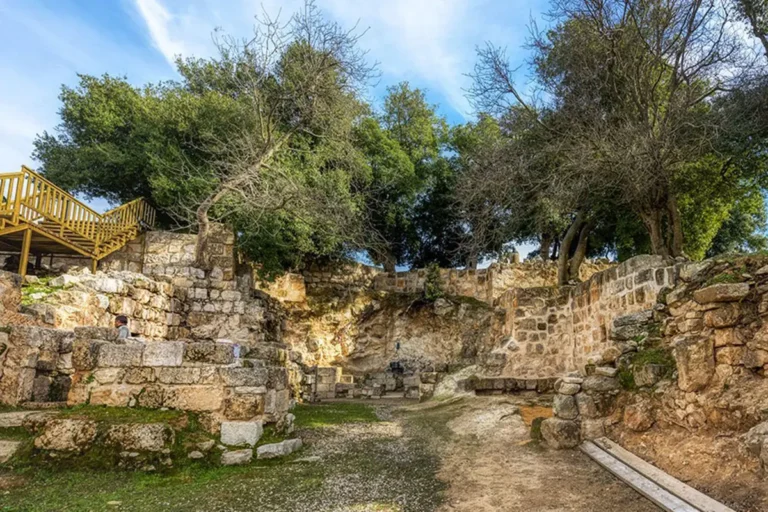
On the main tell, the excavators uncovered a courtyard building with casemate walls and, in a later level, the palace-fort; one room was used for weaving. On Mound A, about 200 m away, stood an open-court sanctuary of the Iron Age I, about 24 × 12.6 m, with a tripartite building and a courtyard. Chalices and a cylindrical incense stand were found there; the sanctuary went out of use in the later 10th century BC.
Open-Court Sanctuary
An Iron Age I shrine on Mound A, with chalices and an incense stand.
The Palace-Fort
A building burned in the early 6th century BC, perhaps in 582 BC.
Ammonite Ostraca
Inscribed sherds, including a letter about woven wool.
Ancient Cemetery
Late Iron Age and Persian graves with bronze, seals and jewellery.
Inscriptions and the Cemetery
Tell el-Mazar produced three inscribed sherds and four ostraca — texts written in ink on pottery. Three ostraca of the early 6th century BC show features of the Ammonite script; one, found in the palace-fort, is a letter about woven wool. Another ostracon is in Aramaic, of the 5th century BC. Graves cut into Mound A form a cemetery of the Late Iron Age and Persian periods, with finds including a bronze bowl, a scarab, a stamp seal, carnelian beads, anklets and rings.
Destruction, Rediscovery, and Restoration
Khair Yassine of the University of Jordan excavated Tell el-Mazar with the Department of Antiquities in four seasons, in 1977–1979 and 1981. The cemetery was published in 1984 and the final report on the tell, by Yassine and Eva van der Steen, in 2012. The site has not been restored.
Visiting Tell El-Mazar Today
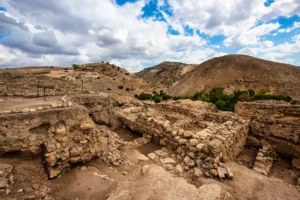
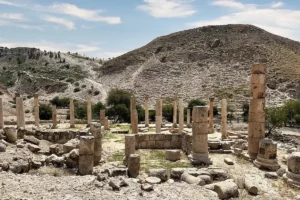
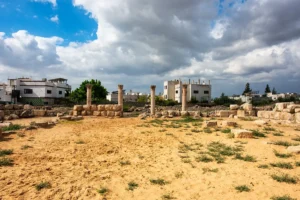
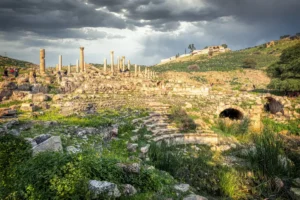
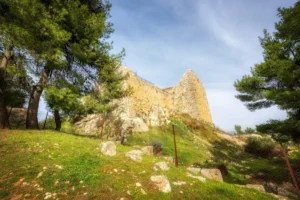
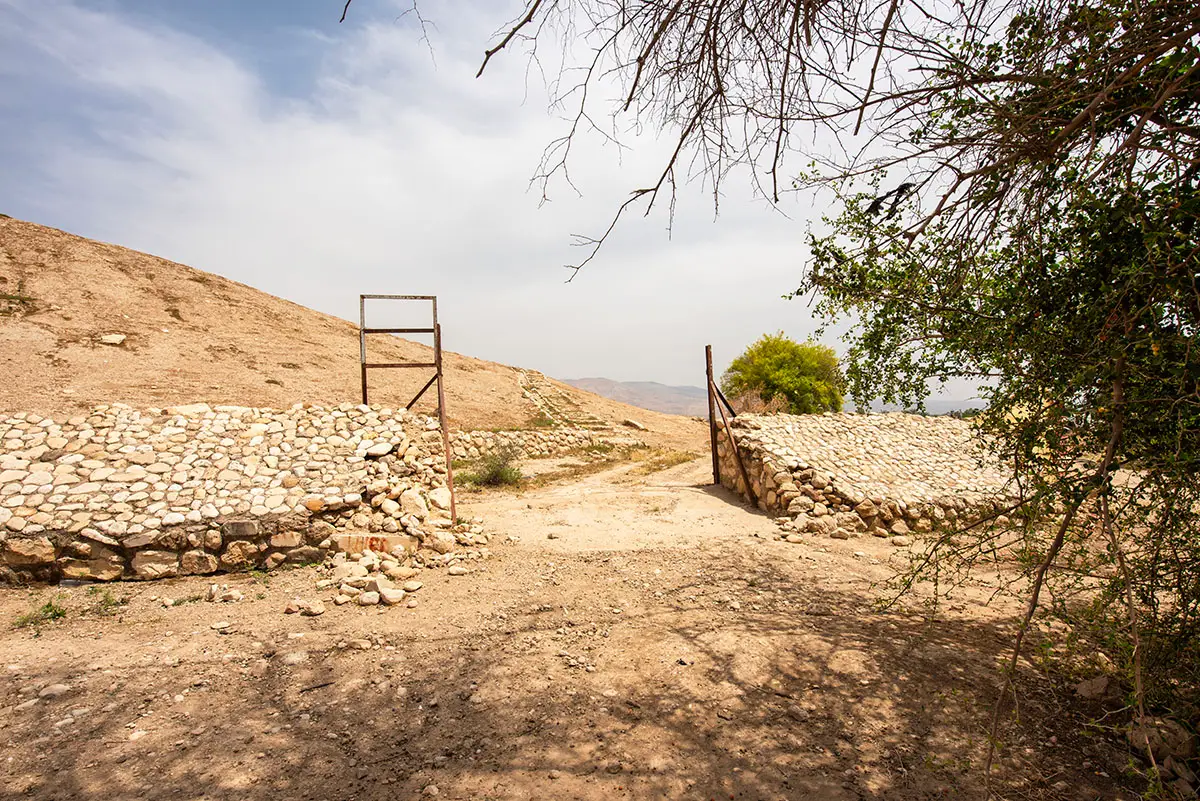
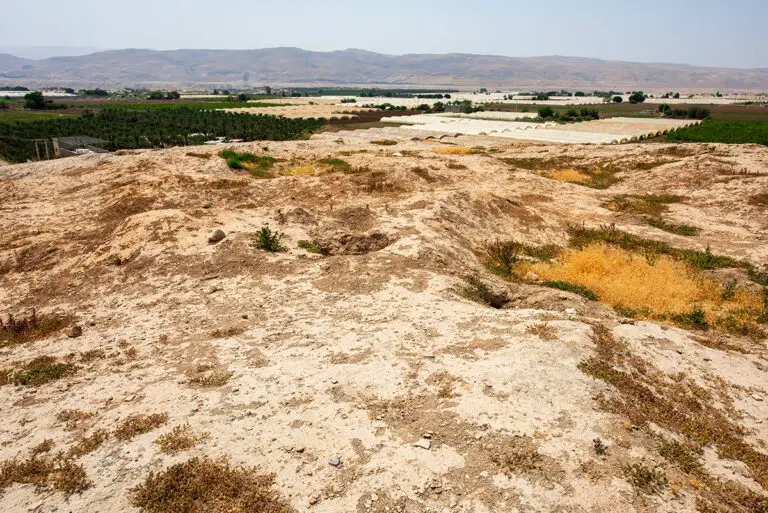
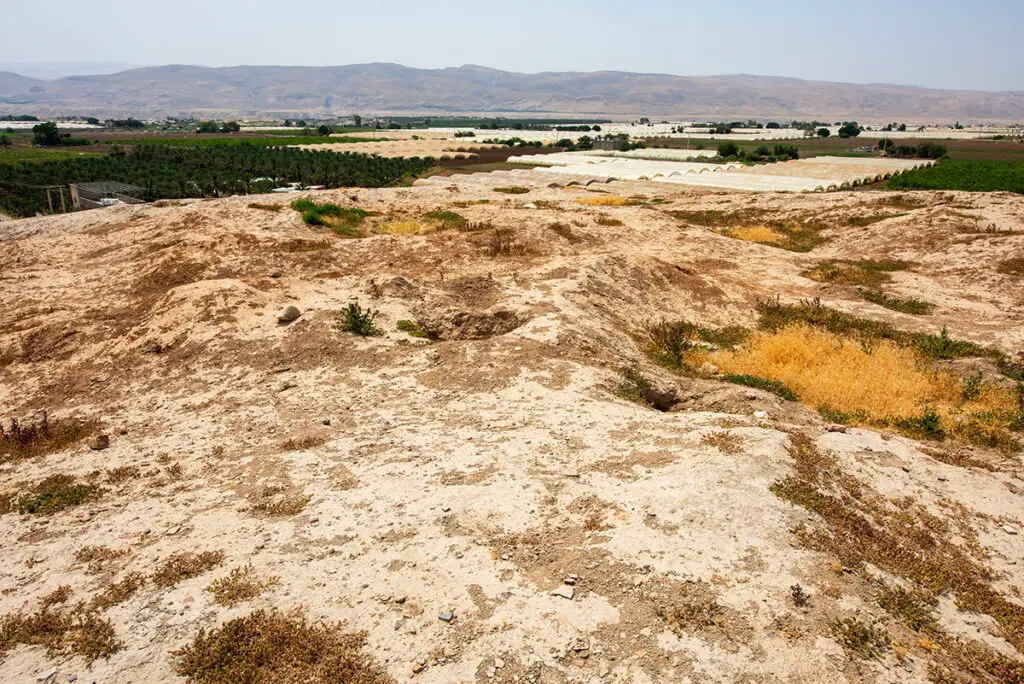
Tell el-Mazar is an unrestored mound in farmland, open and free to visit; the excavated remains are modest, but the view across the valley is wide. Combine it with Tell Deir Alla nearby. Our 360° panorama shows the site.
Further reading: Yassine & van der Steen, Tell el-Mazar II (2012); Richelle, MAARAV 22 (2018), on the Tell el-Mazar ostraca.