













On the arid foothills above the Jordan Valley, near the Damiya Bridge, hundreds of great stone tables stand along the ridges. These are dolmens — burial monuments of the Early Bronze Age, more than five thousand years old — and Damiya is the largest field of them in Jordan.
Where Is the Damiya Dolmen Field?
The dolmens lie on the eastern foothills of the Jordan Valley, close to the Damiya Bridge — the Prince Muhammad Bridge — over the Jordan, in Balqa Governorate. The slopes are dry and rocky, cut by small valleys, with wide views over the valley floor.
Historical Context and Origin
Dolmens were tombs. Those excavated in this region date to the Early Bronze Age I, roughly 3700–3000 BC, and the pottery found with the Damiya dolmens fits that date. They belong to a tradition of megalithic burial concentrated along the eastern side of the Jordan Valley. When the archaeologist Moshe Stekelis excavated here in 1942–1943, he found both crouched burials and cremated remains, sometimes several in one tomb.
Architectural Design
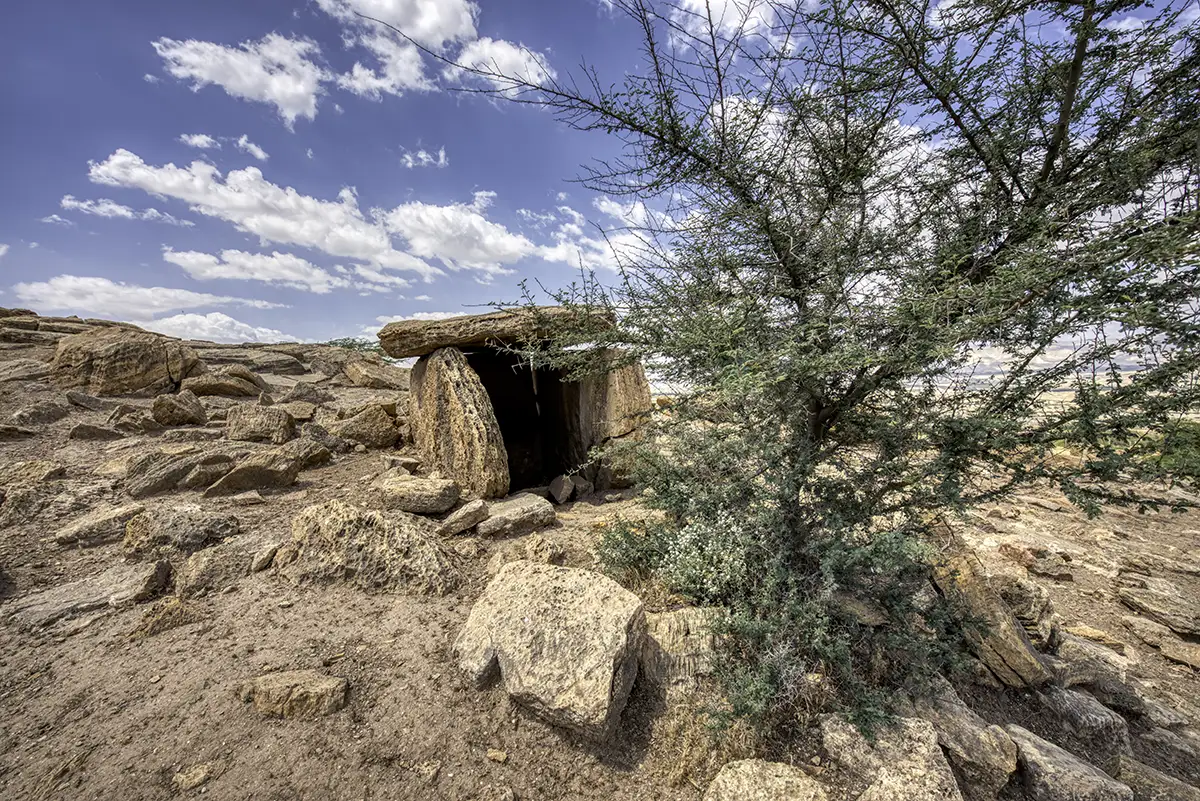
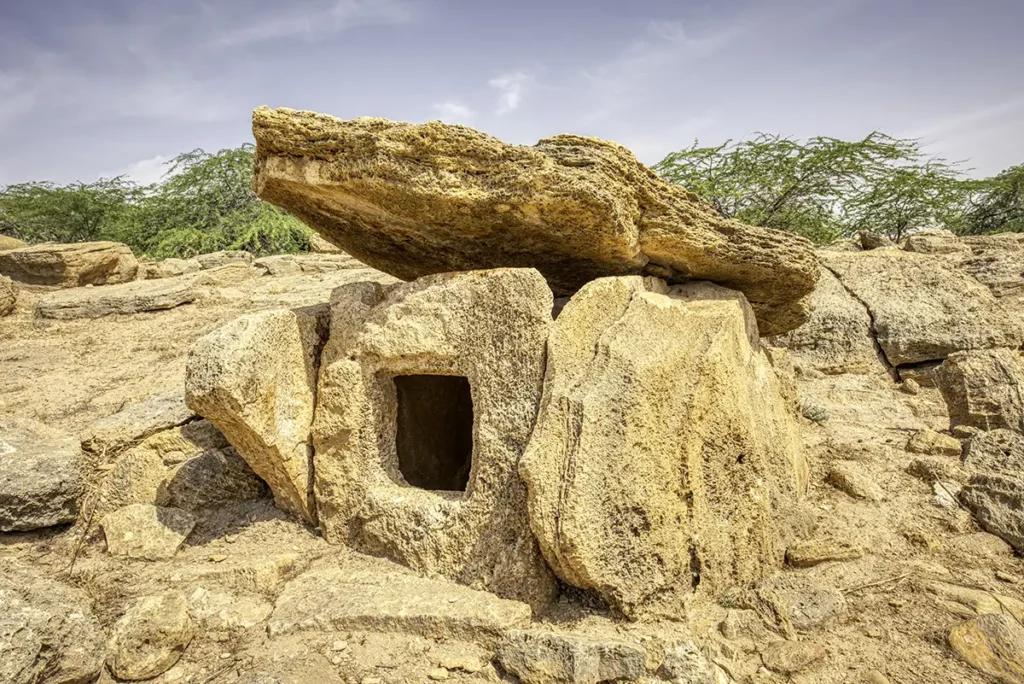
The dolmens are built of local travertine and sandstone, most of them aligned north–south. Rough side slabs carry a heavy capstone, while the front and back stones are often carefully worked. Many front slabs have a small framed “porthole”, which may have allowed the tomb to be reopened, and many dolmens were once covered by a mound of earth and stones. They average about 3 metres long, 1 metre high and 1 metre wide; the largest reach 7 metres.
Hundreds of Dolmens
Around 300 dolmens survive — the largest dolmen field in Jordan.
Porthole Slabs
Many front slabs have a small framed opening, perhaps for later burials.
Massive Capstones
Rough side slabs carry heavy capstones; some dolmens are up to 7 m long.
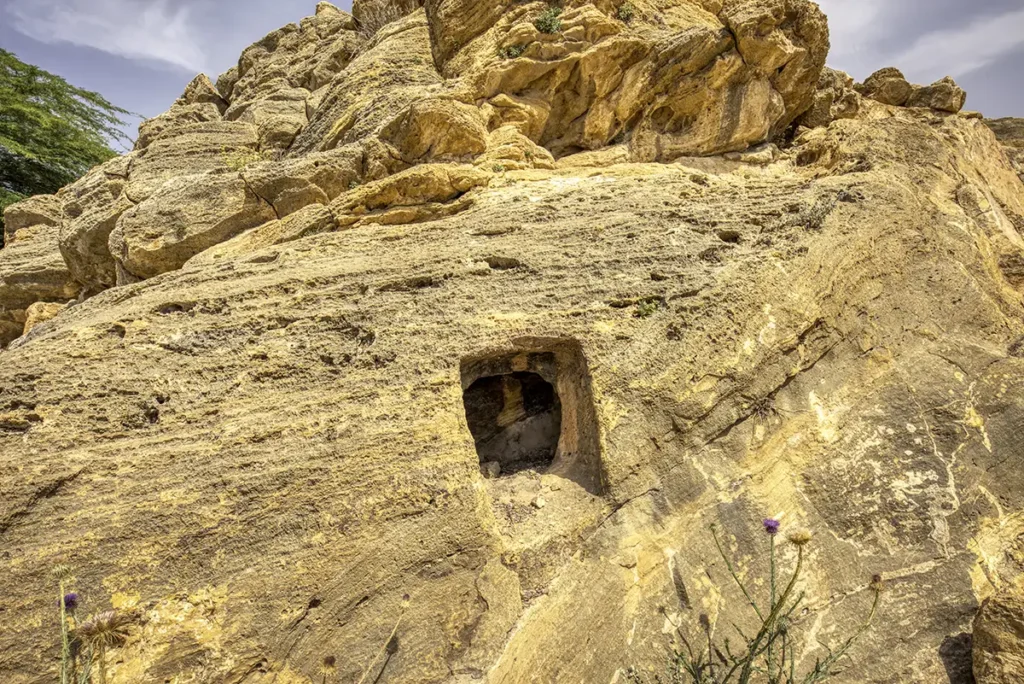
Rock-Cut Tombs
Tombs cut into the sandstone outcrops add to the landscape of the dead.
Rediscovery and Threats
The travellers Irby and Mangles described the dolmens in 1817, and Stekelis recorded 164 of them in 1942–1943; later surveys counted more than 300. Since then a travertine quarry has cut into the middle of the field, destroying dolmens and leaving some standing on islands of rock. The site was placed on the World Monuments Watch in 2010 and 2014, and in 2010 the Department of Antiquities declared a protected area, now an archaeological park open to visitors.
Visiting the Damiya Dolmen Field Today
Walk the ridges to find the dolmens — the porthole dolmens and the great capstones are the most striking — and look for the rock-cut tombs in the sandstone outcrops. The slopes are rough and hot, so come in the late afternoon with water and good shoes.
Further reading: World Monuments Fund: Damiya Dolmen Field.