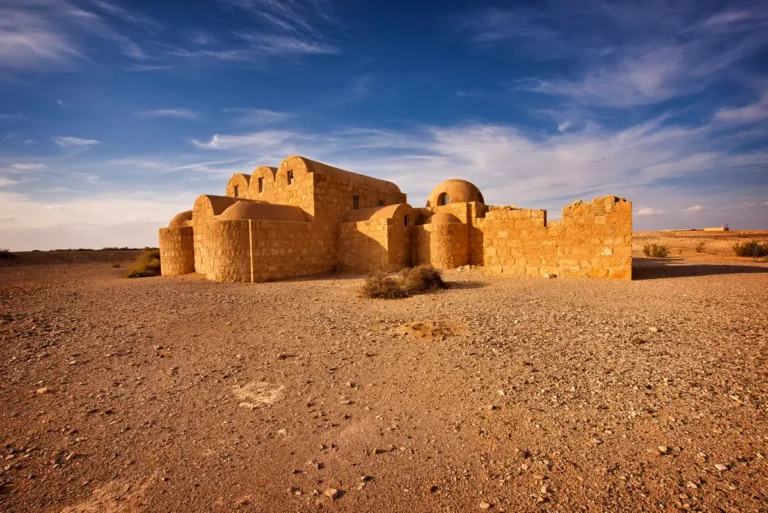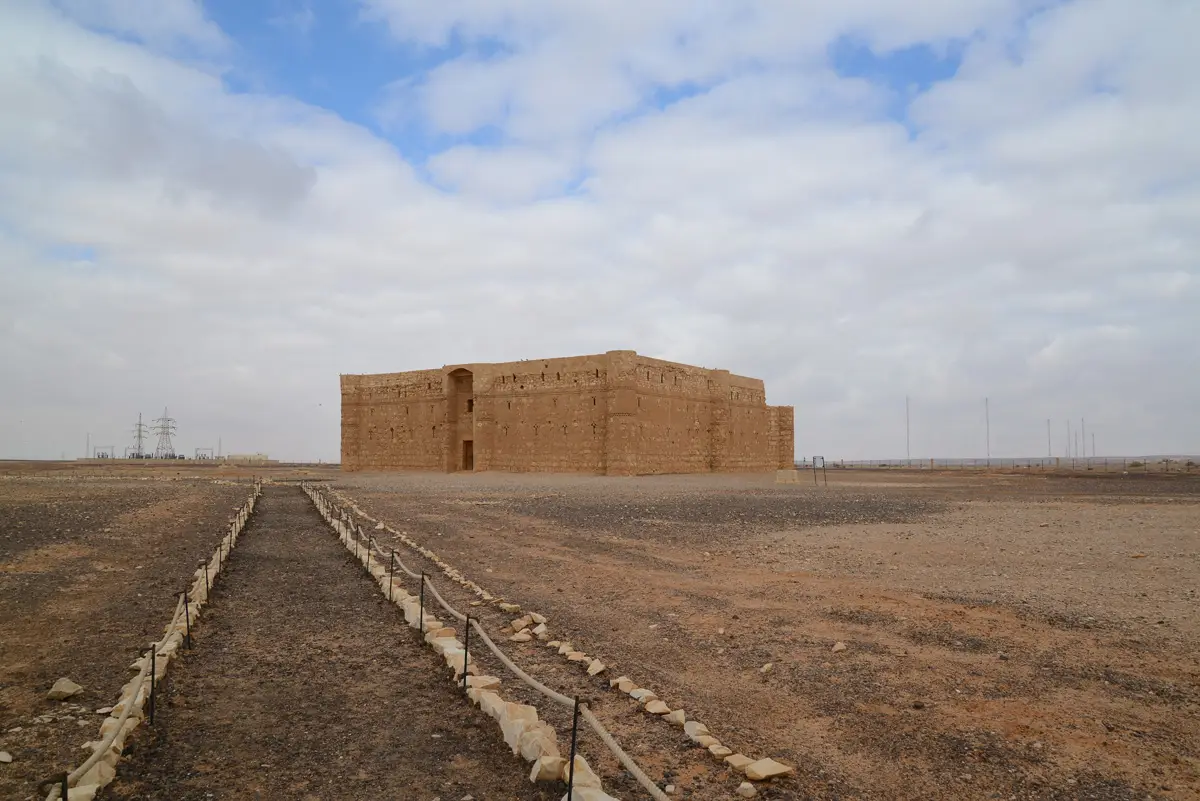
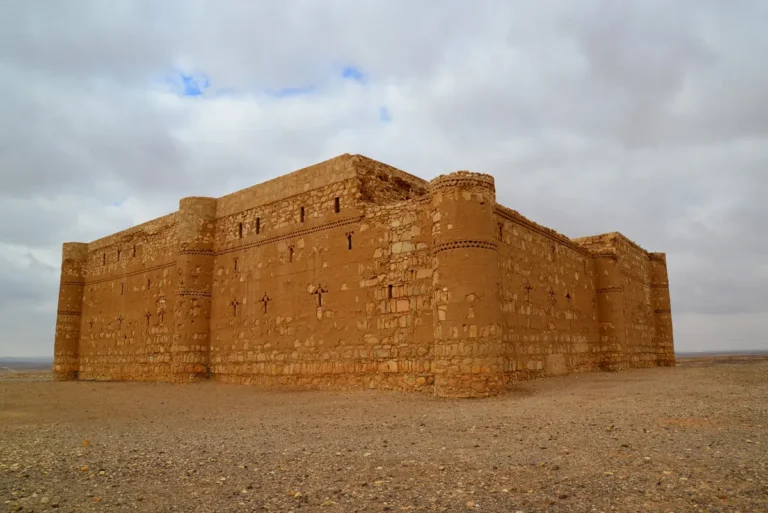


Seen from the road across Jordan’s eastern desert, Qasr Kharana looks like a fortress: a square stone building with rounded towers and narrow slits, alone on an open plain. Inside, the impression changes. A courtyard is ringed by two floors of vaulted rooms, and a painted prayer high on an upstairs wall shows that the building was already standing in AD 710.
Where Is Qasr Kharana?
Qasr Kharana stands beside Highway 40, the road from Amman to Azraq, about 60 km east of Amman, on a low rise above Wadi al-Kharana. Qasr Amra lies about 16 km further east, so the two are usually visited together, often continuing to Qasr Azraq.
Historical Context and Origin
Kharana belongs to the Umayyad period (AD 661–750), when the caliphs ruled from Damascus. Its date rests on a painted Arabic text in an upstairs room: a visitor’s prayer dated Muharram AH 92, which corresponds to 24 November 710. It is not a building inscription, so it tells us only that the building existed by then. Who built it is unknown. Scholars have suggested the early Umayyad caliphs, al-Walid I (705–715) or, as a minority view, an even earlier date.
Architectural Design
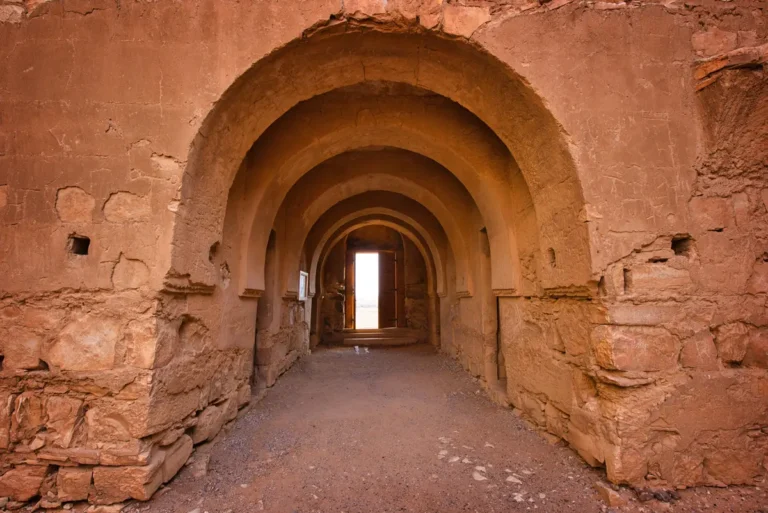
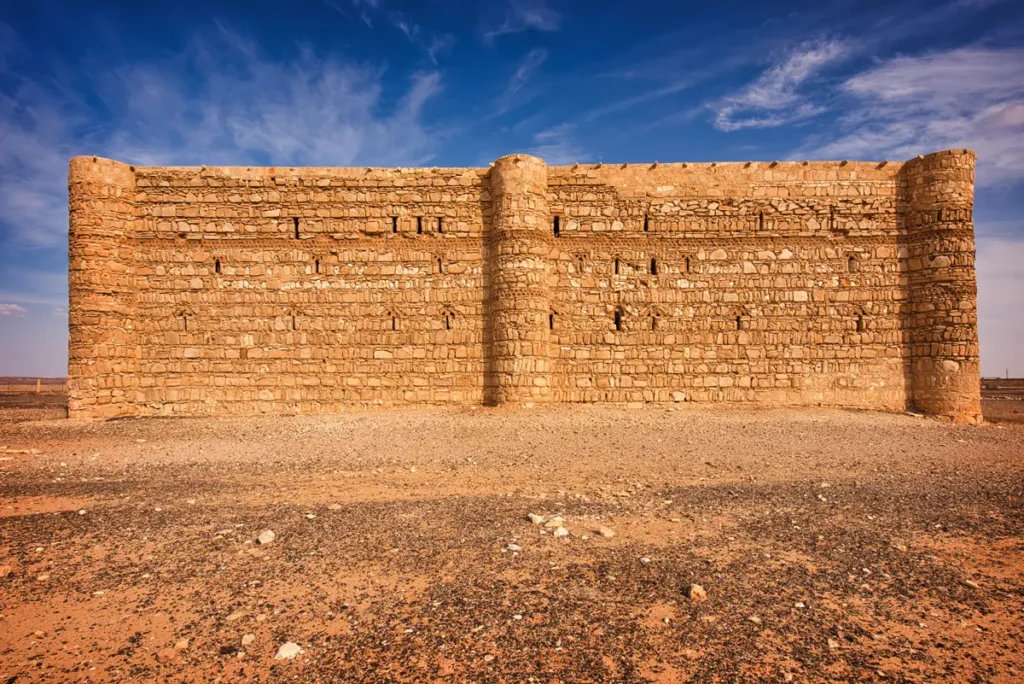
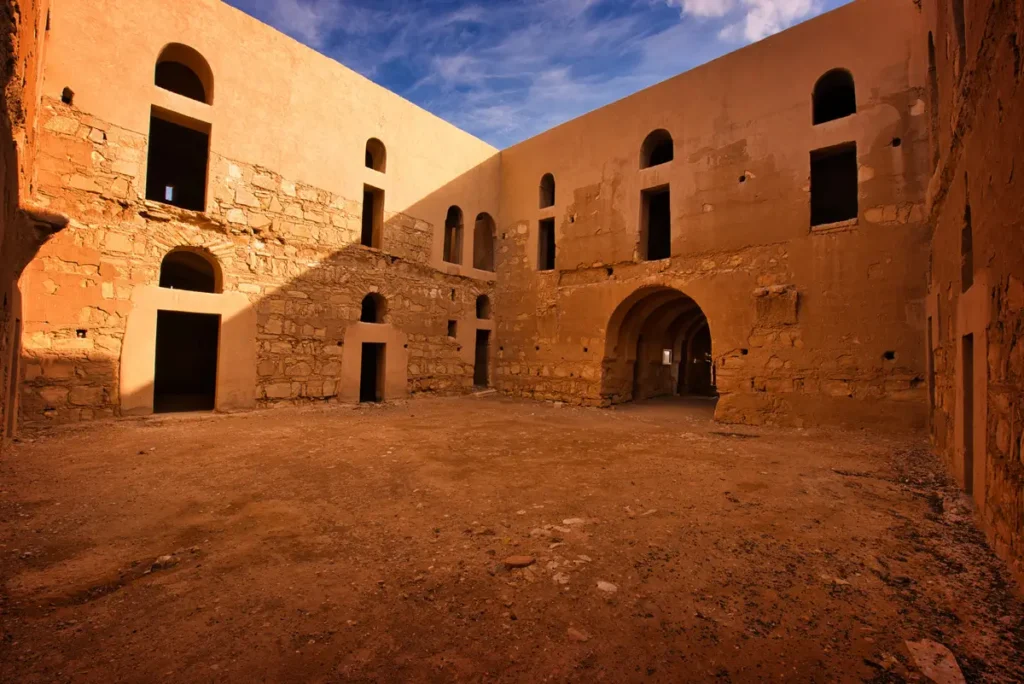
The building is about 35 m square, with a single gate in the south façade, round towers at the corners and half-round towers in the middle of the other sides. All the towers are solid, and the slits are set high and too narrow for archers: they were for light and ventilation. Rooms flanking the entrance hall were probably stables and stores, and two long staircases lead to the upper floor. Some 60 rooms are arranged on two floors in suites (bayts) around larger halls. Most of the decoration is upstairs: moulded stucco rosettes, engaged colonnettes, blind arcades and squinches carrying half-domes, a feature borrowed from Sasanian Iran.
A Dated Prayer
A painted Arabic prayer upstairs is dated 24 November 710 — the key to the building’s date.
Not a Real Fort
Its towers are solid and its narrow slits let in light and air, not arrows.
Suites of Rooms
Some 60 rooms are grouped into suites (bayts) around larger halls on two floors.
Stucco Decoration
Upstairs, rosette friezes, small columns and squinches carry half-domes.
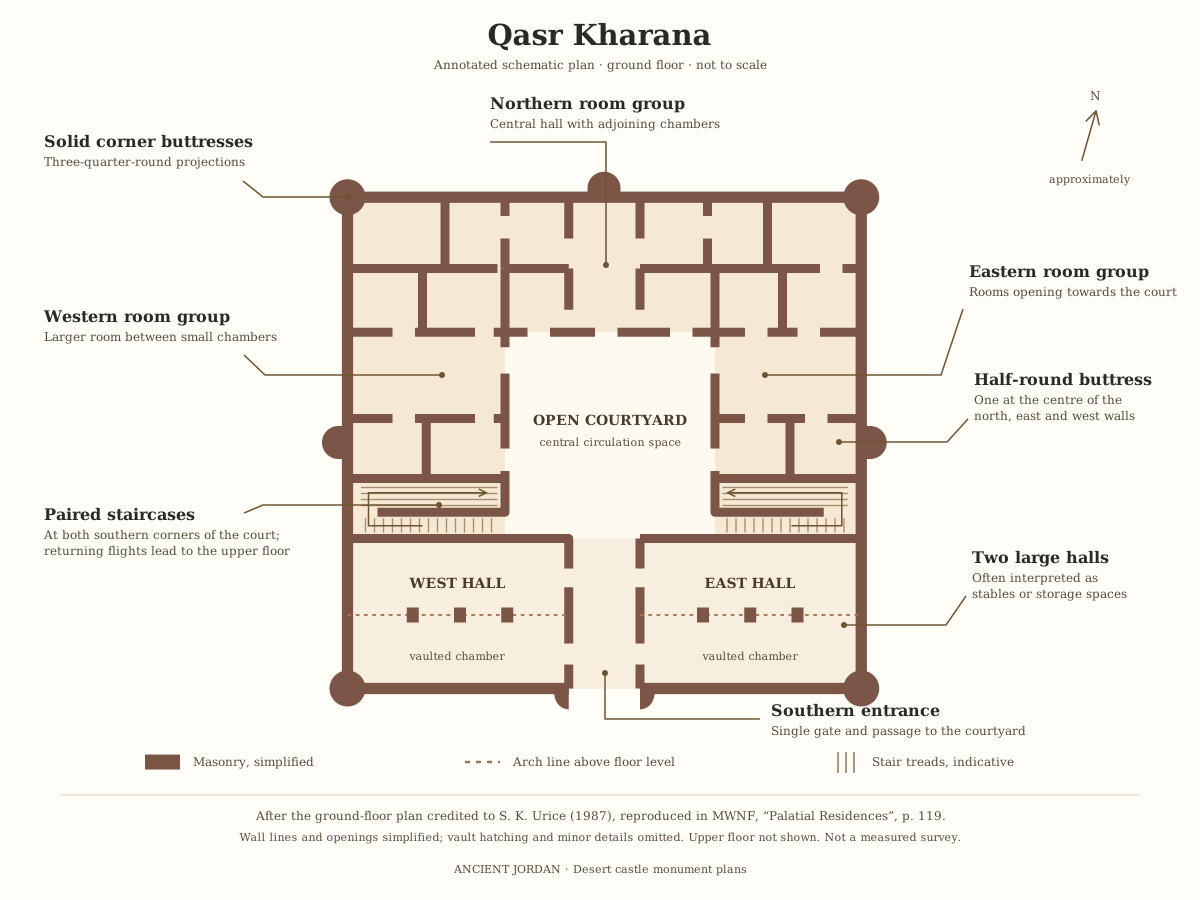
Qasr Kharana: schematic plan
Schematic ground-floor plan of Qasr Kharana, after S. K. Urice (1987)
Open drawingThe painted prayer of AD 710
Painted in ink in early Kufic script above a doorway in an upstairs room.
A prayer asking God’s mercy and forgiveness for ʿAbd al-Malik ibn ʿUmar, ending with a request to readers to say “Amen” and the date: Monday, three nights before the end of Muharram, year 92. (Summary of N. Abbott’s 1946 reading.)
Readings of the names differ; this follows Abbott, Ars Islamica 11–12 (1946).
Fortress, Caravanserai or Meeting Place?
Kharana has been called a fort and a caravanserai, but neither fits well. The towers do not work as defences, and its only water came from a plastered cistern in the courtyard fed by rainwater, too little for large caravans. The archaeologist Stephen Urice, who surveyed and excavated the site in 1979, proposed that it was a place for occasional meetings between Umayyad officials and the leaders of the desert tribes. The idea is widely accepted, but it remains an interpretation, and the building’s exact purpose is still debated.
Destruction, Rediscovery, and Restoration
How and when Kharana fell out of use is unclear. Western travellers recorded it from the late 19th century: John Gray Hill in 1895, Alois Musil between 1898 and 1901. Urice’s fieldwork in 1979 was published in 1981 and 1987. The Department of Antiquities restored the building in the late 1970s; the cement and plaster used then make some original features hard to read today.
Visiting Qasr Kharana Today
The site is entered through the visitor centre. Admission is 3 JOD for visitors and 0.25 JOD for residents. Allow 20–30 minutes, and climb to the upper floor to see the decorated rooms and look for the painted inscription. For practical details, see our Qasr Kharana travel guide.
Further reading: Archnet — Qasr Kharana; AramcoWorld — Qasr Kharranah (1990); Urice, The Qasr Kharana Project, 1979 (ADAJ 25).