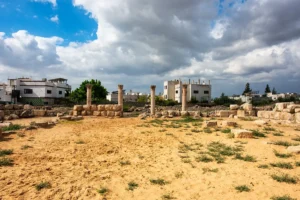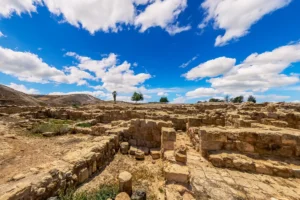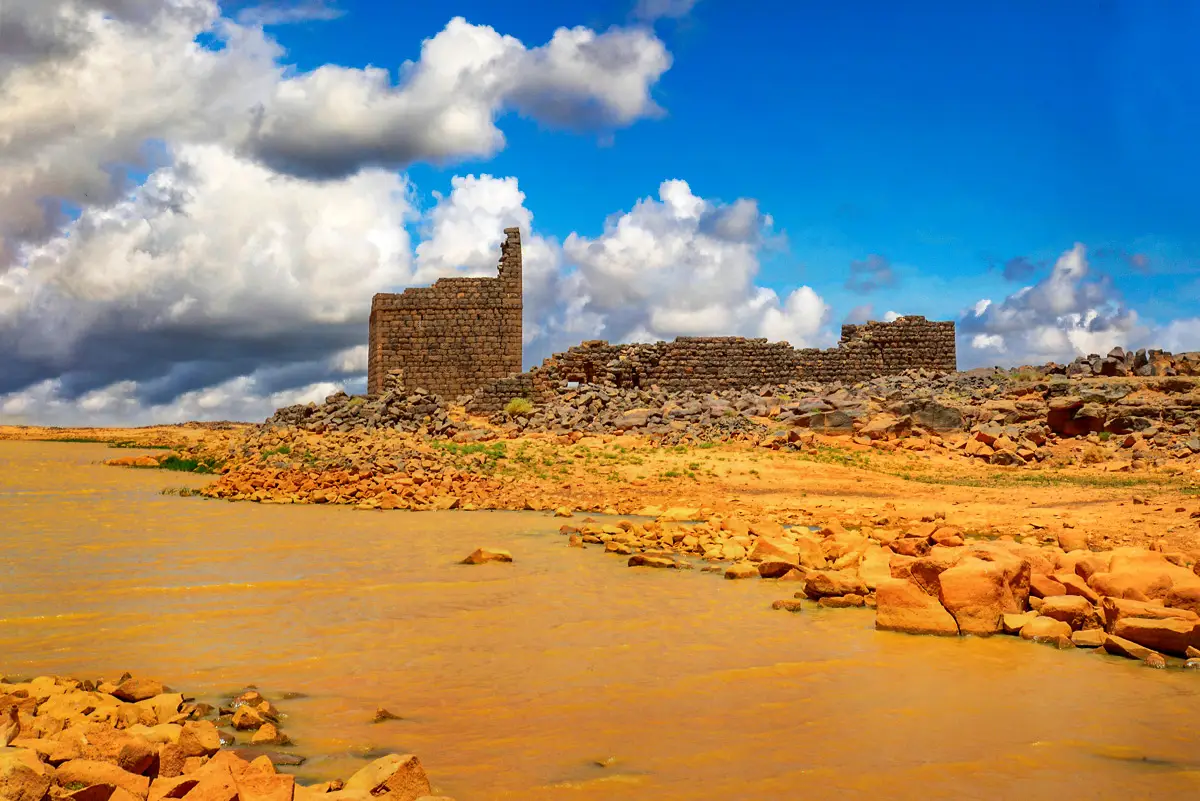












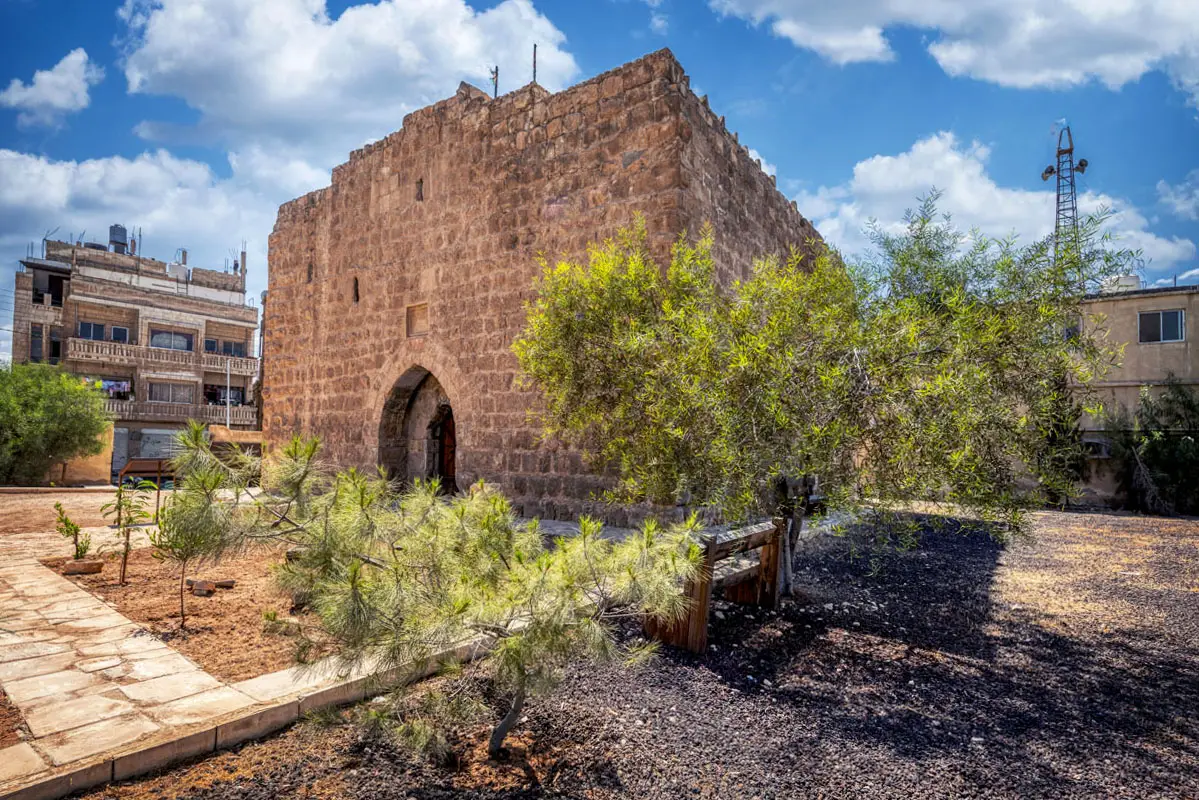

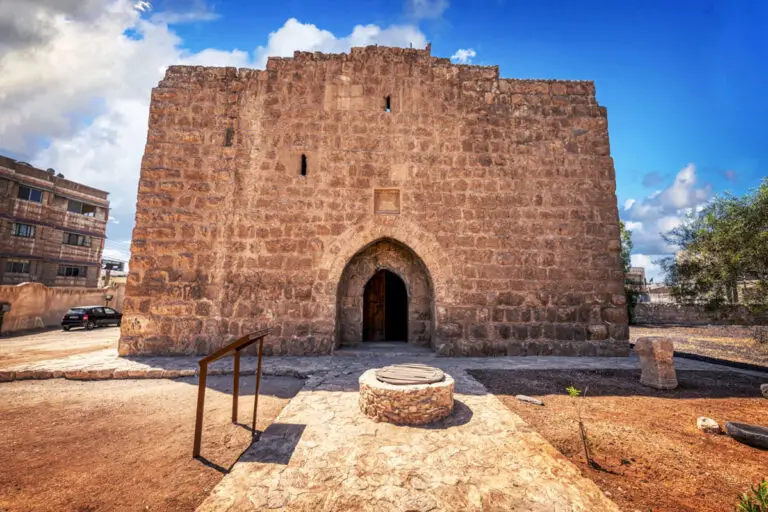

In the middle of busy Zarqa, a square stone tower stands on a spur above the wadi. Qasr Shebib was a fort on the Hajj road for centuries, and around it the first settlers of modern Zarqa built their homes in 1903.
Where Is Qasr Shebib?
The fort stands in the centre of Zarqa, about 20–25 km north-east of Amman, on a spur between Wadi Zarqa and Wadi Huweijir. It lies next to Zarqa First Secondary School, within the school grounds.
Historical Context and Origin
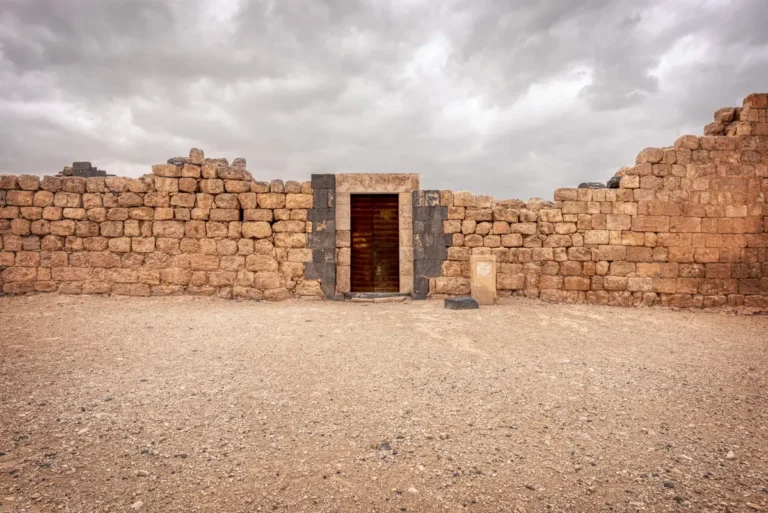
A Latin inscription of AD 253–259 built into the walls suggests a Roman fort stood here first. The present building is probably a medieval tower, for which scholars have proposed an Ayyubid or Mamluk date, later reused and rebuilt under the Ottomans. It was first called “Qasr Shebib” in the Hajj itinerary of 1563; local tradition links the name to Shabib, a legendary ruler. The Ottomans used it as a base against the Bani Sakhr in 1812 and restored it in 1899, and in 1903 Chechen families settled around it, founding the modern town.
Architectural Design
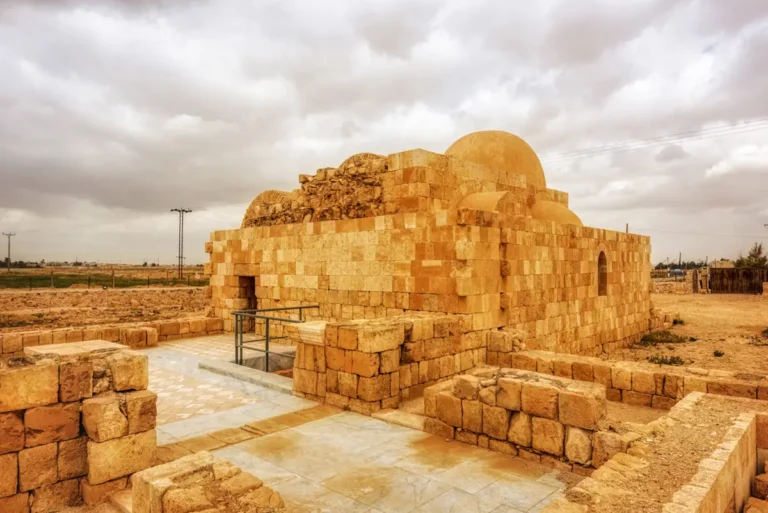
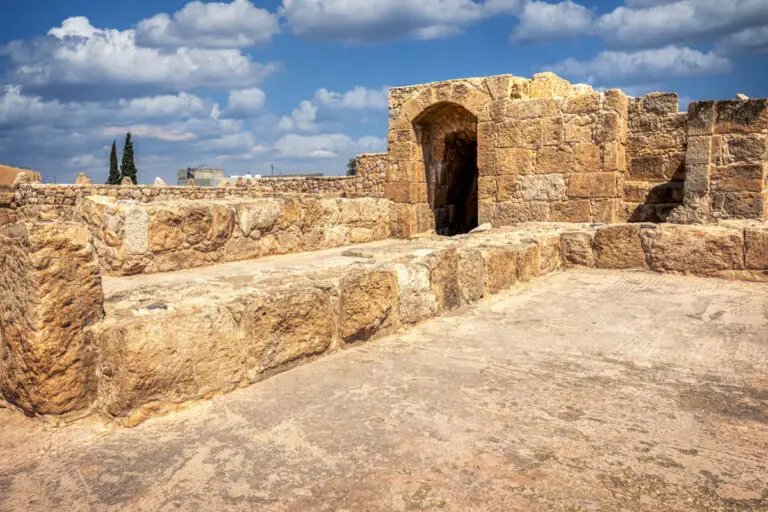
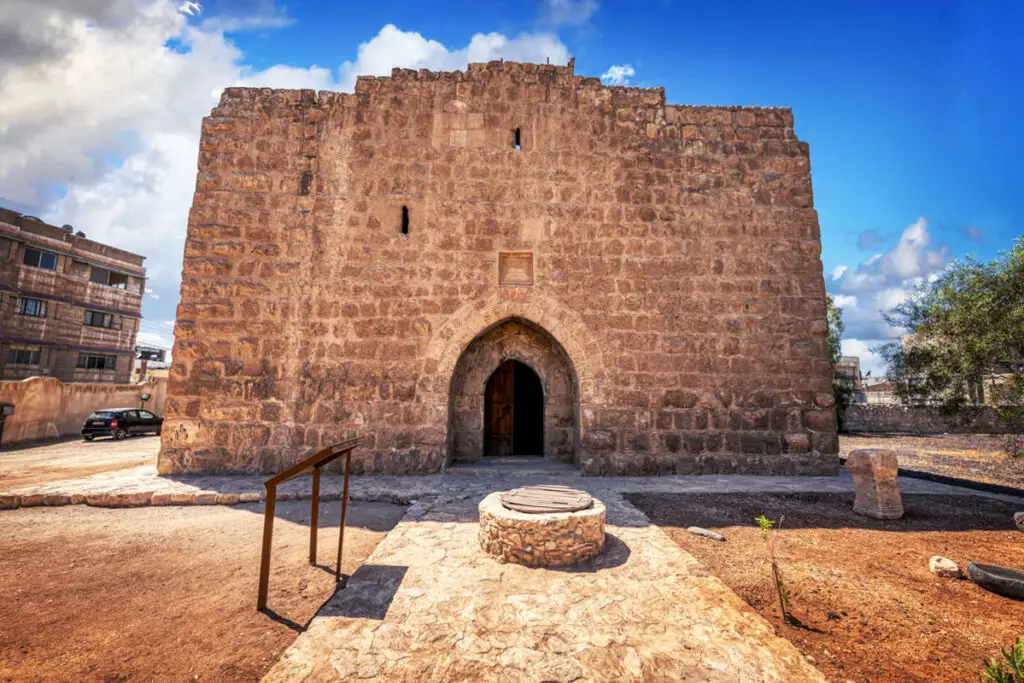
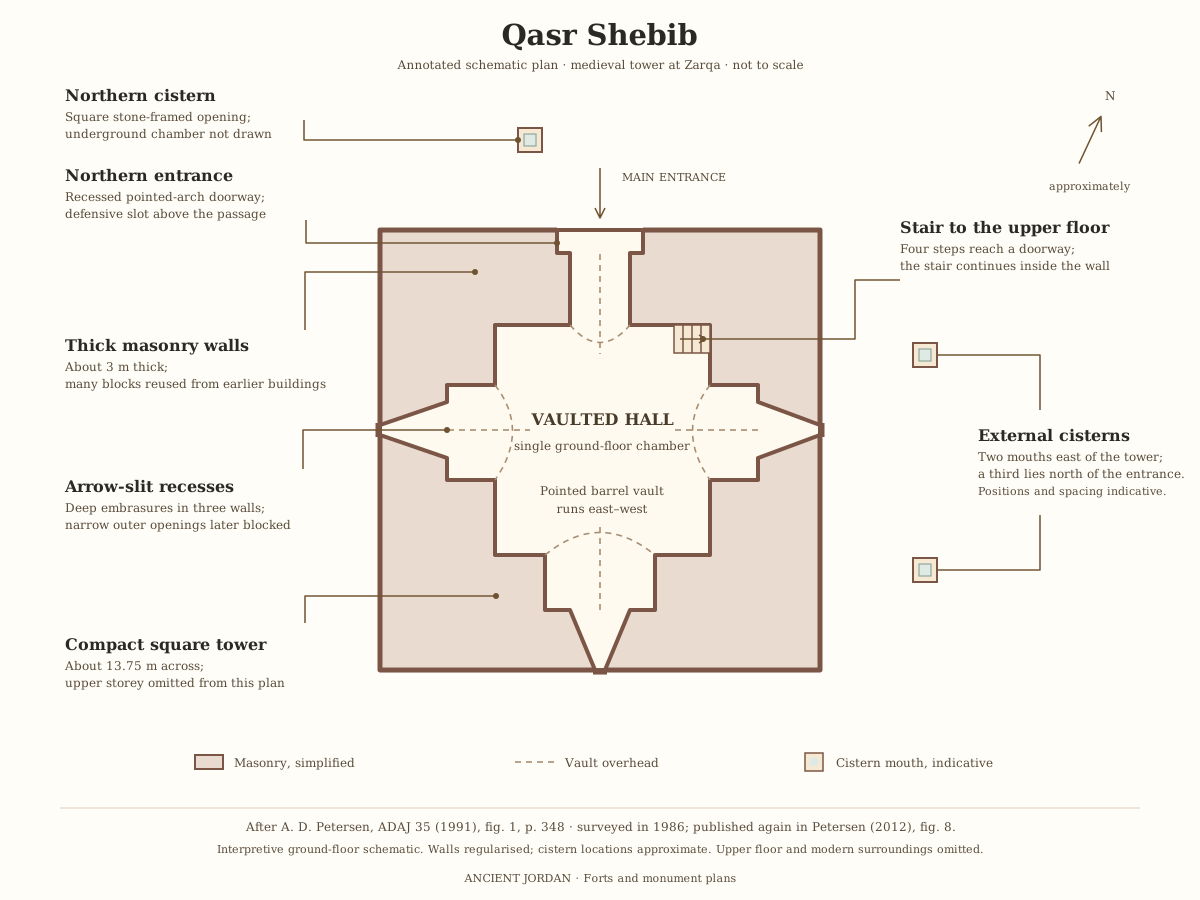
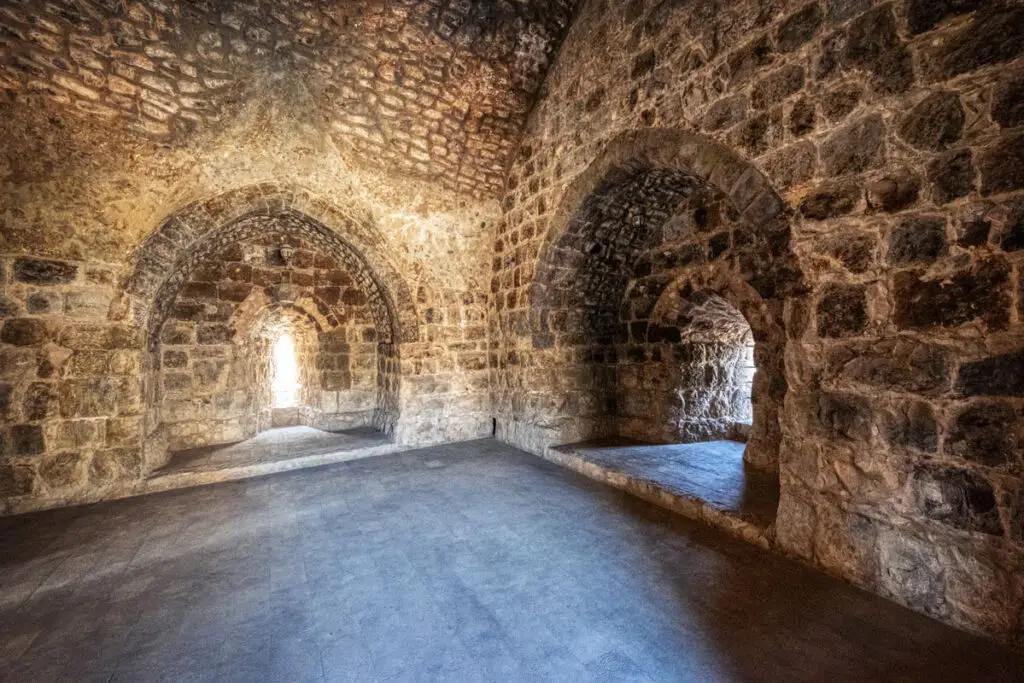
Qasr Shebib is a compact tower about 14 m square and 8 m high, built of large limestone blocks with rusticated faces, many reused from a Roman building. The entrance is on the east side. The ground floor is a single tall hall under a pointed barrel vault, about 6 m high, with deep recesses for arrow slits. A stair in the thickness of the wall leads up to a ruined upper floor, and triangular merlons crown three sides.
A Tower-Fort
A compact square of 14 m with walls about 3 m thick.
Reused Roman Stone
Rusticated blocks and a Latin inscription of AD 253–259.
Vaulted Hall
A tall pointed vault on the ground floor, lit by arrow slits.
Cisterns
At least three cisterns outside the walls.
Qasr Shebib
Schematic ground-floor plan of Qasr Shebib, after Petersen (1991)
Open drawingLatin inscription of the Roman fort (AD 253–259)
A Roman Latin inscription, dated AD 253–259, was recorded on a stone reused in Qasr Shebib’s wall by the Princeton Expedition in the early twentieth century. It refers to a Roman fort and supports the existence of an earlier military installation at the site. It does not date the standing medieval tower. The publication reference is Princeton Expedition, Division III, Section A, Part 2, inscription no. 12. Petersen, The Medieval and Ottoman Hajj Route in Jordan, pp. 58–59
[…] imp(eratores) Augg(usti) tute[lae] gratia ex
Palaes[tina in Arabia]m tra[nstu]lerunt, [c]astra quoque (e)x solo
oppo[rtuno loco] exstruxerunt per Aurel[ium Theone]m leg(atum)
Aug(ustorum) […]
[…] the emperors Augusti, for protection, transferred [troops] from Palestine into Arabia. They also built a military camp from the ground up, in a suitable location, through Aurelius Theo, legate of the emperors. […]
The Latin uses the published reading reproduced by Christian Wallner, following Michael Speidel. Square brackets mark restored missing letters; parentheses expand abbreviations. The opening’s uninterpretable traces are represented by an ellipsis. Wallner, ZPE 129 (2000), p. 105
The English translation incorporates the published restorations. “[Troops]” supplies the understood object of “transferred”; its name or description is missing. Latin reading and historical interpretation
The emperors are identified as Valerian and Gallienus, although their names do not survive in this passage. Aurelius Theo is a restored identification of the governor of Arabia, and his tenure supplies the proposed date AD 253–259.
Castra means a military camp or fort; ex solo indicates construction from the ground up. Wallner, p. 105, especially note 55
A Fort in the Heart of Zarqa
Kennedy and Petersen called it the first surviving fort on the pilgrim road south of Damascus. At least three cisterns outside the walls stored water for travellers. Today the fort is surrounded by the city it helped to create, and in 2017 the Department of Antiquities announced plans to separate it from the school and turn it into a cultural space and archaeological park.
Destruction, Rediscovery, and Restoration
Egyptian officers of the 1820s–30s recorded the fort as ruinous. The Ottomans restored it in 1899, and it is now maintained by the Department of Antiquities and the Ministry of Education.
Visiting Qasr Shebib Today
The fort is open to visitors and entry is free. Allow about 15 minutes. See our Qasr Shebib travel guide for directions.
Further reading: AramcoWorld — Guardians of the Pilgrim Wells (2004); Petersen, The Medieval and Ottoman Hajj Route in Jordan (2012).