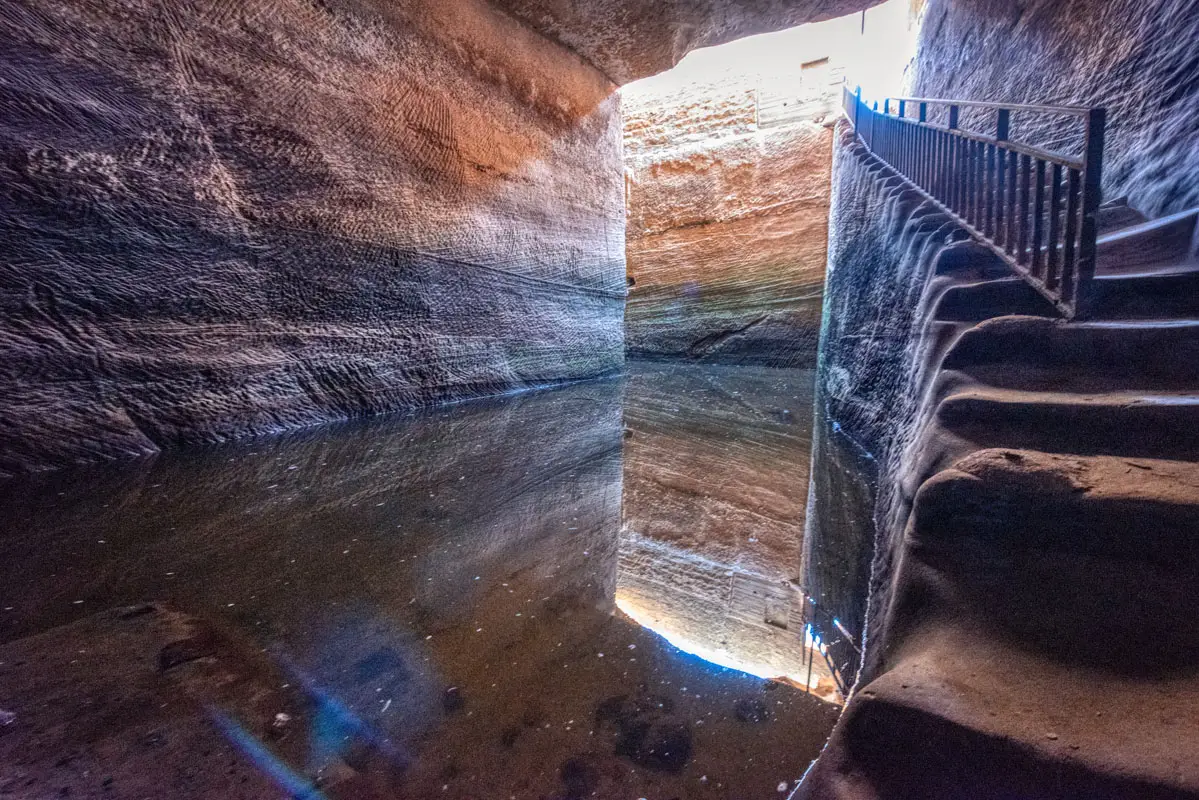


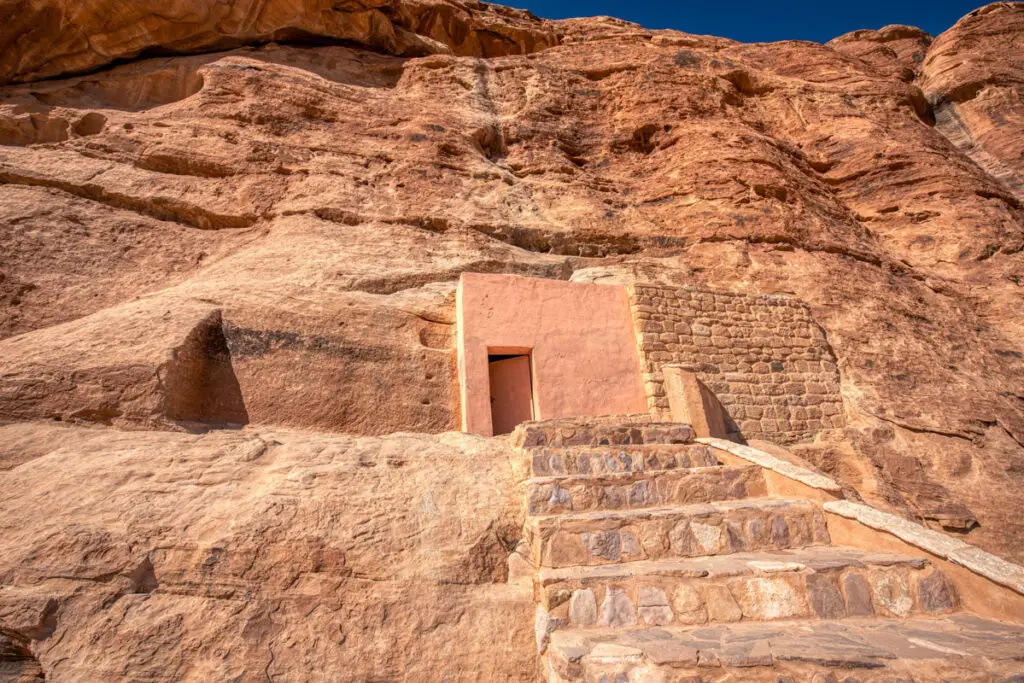
Near Little Petra, a doorway in the sandstone opens onto steps that lead down into darkness and still water. This is a Nabataean cistern, cut into the rock to store the rare winter rain — and it still holds water today.
Where Is the Nabataean Water Reservoir?
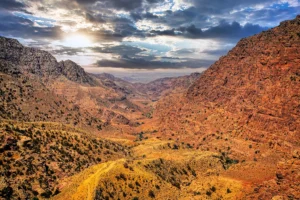
The reservoir lies near Little Petra (Siq al-Barid), in the al-Bayda area about 9 km north of Petra. In Nabataean times al-Bayda was a farming district and a stopping place for caravans on the way to and from Petra.
Historical Context and Origin
The Nabataeans were masters of water. Around Little Petra they built a system of cisterns and dams to catch the runoff from the sandstone hills, supplying the people of al-Bayda and, very likely, the trade caravans that rested here before entering Petra. The cistern belongs to the Nabataean period, when Little Petra flourished around the turn of the era.
Architectural Design
The reservoir is a chamber cut into the sandstone. A doorway and a rock-cut staircase lead down to the water, and channels on the rock surface carried rainwater into it from the slopes above. Closed cisterns like this one kept the water cool and limited evaporation through the long dry summer.
Rock-Cut Cistern
A chamber cut into the sandstone to hold rainwater through the dry months.
Steps to the Water
A doorway and rock-cut steps lead down to the water inside.
Catchment Channels
Channels gathered runoff from the bare sandstone slopes.
Caravan Stop
Large cisterns helped make al-Bayda a resting place for caravans bound for Petra.
Water and the Caravan Stop of al-Bayda
The archaeologist Patricia Bikai, who excavated at Little Petra, pointed out that al-Bayda had large Nabataean cisterns, good grazing and the secure, narrow gorge of Siq al-Barid — everything a caravan needed before the last stage to Petra. In 2004 she noted that one large Nabataean cistern was still used by the Amareen Bedouin. Studies of the area by Ulrich Bellwald have mapped how the Nabataeans managed runoff water around Little Petra.
Destruction, Rediscovery, and Restoration
Unlike many ancient waterworks, cisterns like this one were never truly lost: local people went on using them for centuries, and some still hold water today.
Visiting the Nabataean Water Reservoir Today
The reservoir is close to Little Petra and takes about 15 minutes to see; combine it with Siq al-Barid and the Neolithic village of Beidha. Access to the chamber may vary, so check locally, and take care on the steps. Our 360° panorama shows the inside of the cistern.
Further reading: ACOR Newsletter 15.2 (2004), on Little Petra and al-Bayda; Visit Petra — Little Petra.