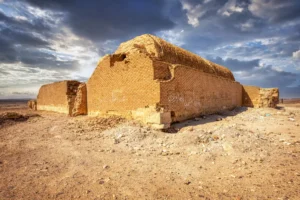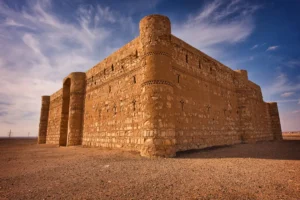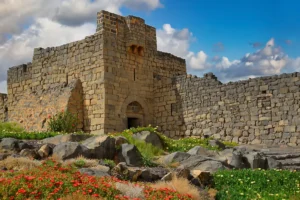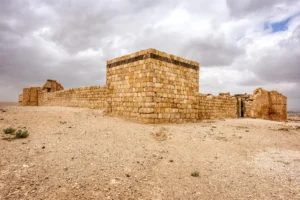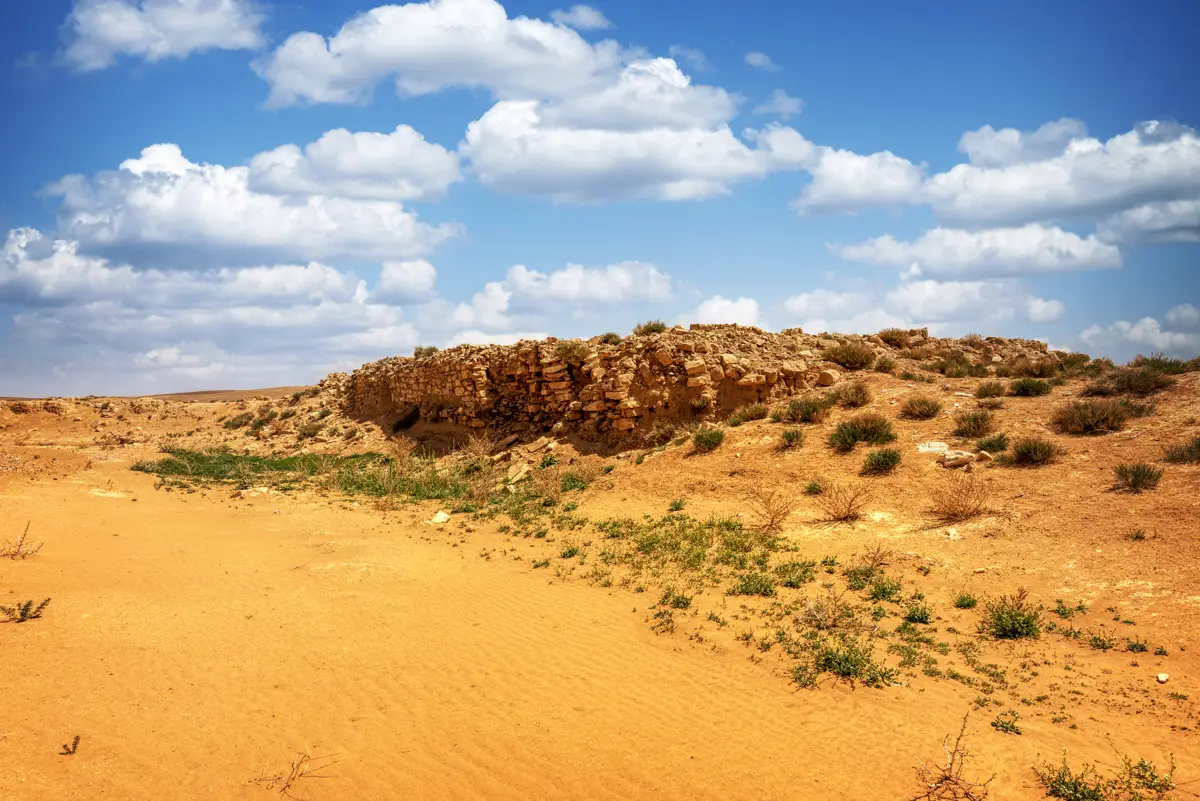


On the open steppe east of Amman, a scatter of low walls, cisterns and dams marks one of the less-known Umayyad sites in Jordan. Qasr Mshash was not a palace but a small settlement, spread over about 2 × 2 km, built where only winter rain could supply water.
Where Is Qasr Mshash?
Qasr Mshash (also spelled Mushash) lies about 40 km east of Amman, north of Highway 40, the road to Azraq. It is reached by a desert track that needs a 4×4. Qasr Al-Muwaqqar is about 19 km to the south-west and Qasr Kharana about 21 km to the south-east, on the old route from Amman towards Azraq and the Wadi al-Sirhan.
Historical Context and Origin
Pottery shows that a small Roman post stood here in the 2nd–4th centuries AD. The settlement visible today is mainly Umayyad, of the 7th and 8th centuries; radiocarbon dates suggest use mostly in the first half of the 8th century. No inscription names a builder, and there is no ruler’s residence. Researchers interpret the western area as a caravan halt on the route from Amman to the Wadi al-Sirhan, with an agricultural estate around it, but this remains a hypothesis. Why the site was abandoned in the 8th century is unknown.
Architectural Design
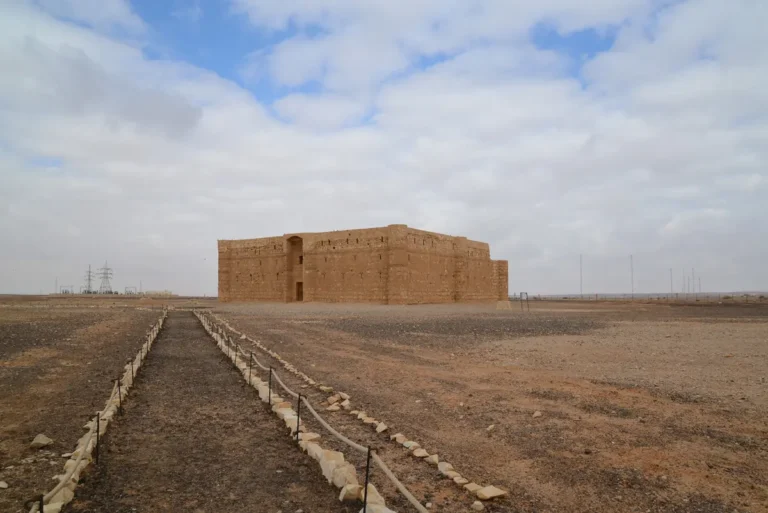
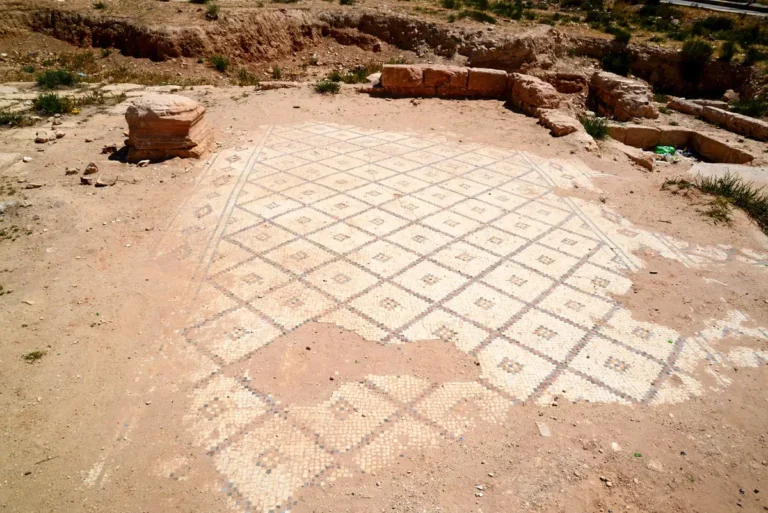
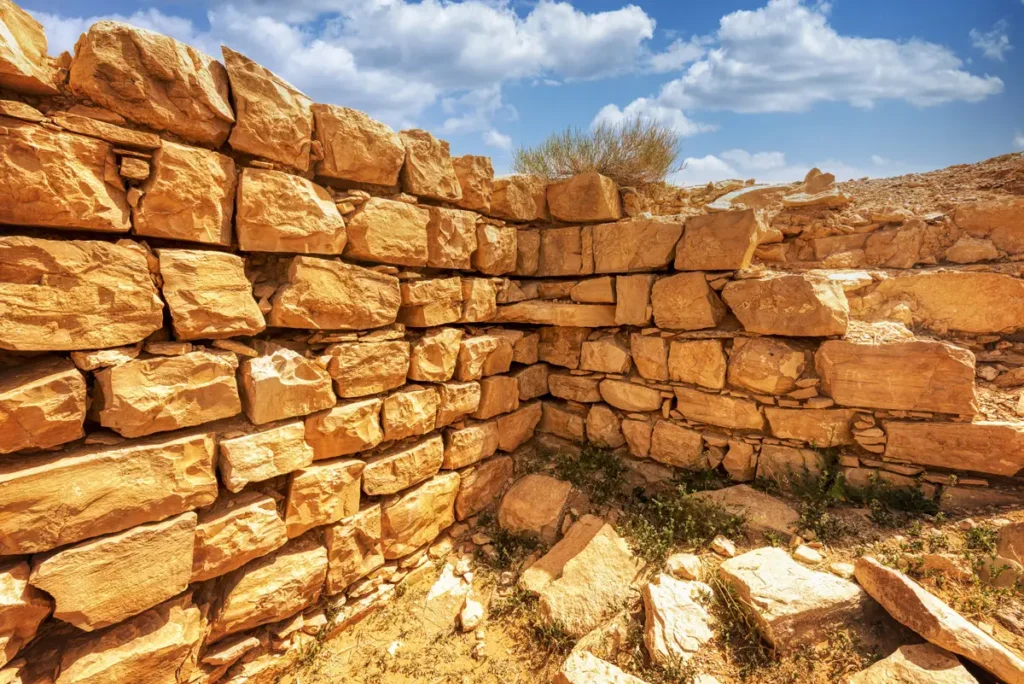
The site has two areas about 1.5 km apart. In Mshash West, the qasr is a square building about 26–27 m across, without towers, built of roughly dressed limestone and plastered inside, with 14 rooms around a 13 × 13 m courtyard. Nearby stand a 40 × 40 m courtyard building of caravanserai type, a bath with marble wall cladding and glass windows, and small houses. Mshash East has a small square building surrounded by houses.
The Qasr
A small square building about 26 m across, with 14 rooms around a courtyard.
Bath and Reservoir
A bath once clad in marble stood beside a rectangular reservoir.
Water Harvesting
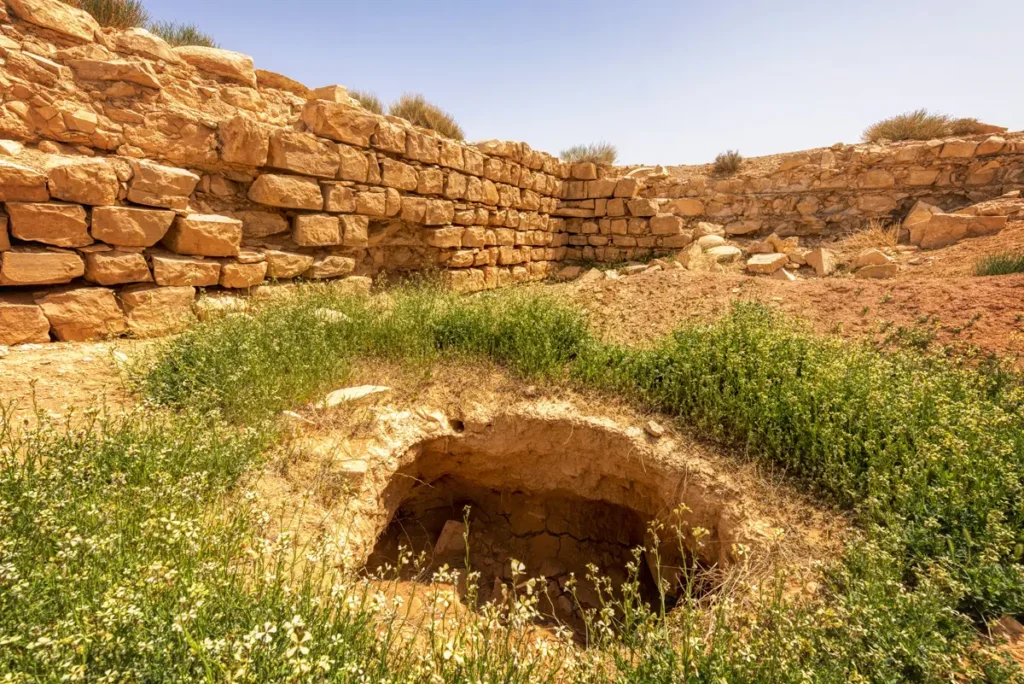
Dams in the wadis and rock-cut cisterns caught the winter rain.
A Caravan Halt?
A 40 × 40 m courtyard building may have served travellers on the road east.
Water in the Steppe
With less than 100 mm of rain a year and no spring, everything depended on catching the winter rain. Walls across the wadis served as dams, rock-cut cisterns stored runoff, and two large reservoirs held about 1,000 and 2,000 m³. A smaller rectangular reservoir, about 18 × 7 m, supplied the bath.
Destruction, Rediscovery, and Restoration
Alois Musil described the site around 1900, and Aurel Stein recorded it during his survey of 1938–39. Geoffrey King studied it in the early 1980s, and Ghazi Bisheh of the Department of Antiquities excavated the qasr entrance and the bath in 1982–83. From 2011 to 2017 a German–Jordanian project (German Archaeological Institute and Department of Antiquities) mapped the whole site and its water system. Illegal digging has badly damaged it, including a machine-dug pit at the qasr in 2014. The ruins have never been restored.
Visiting Qasr Mshash Today
Mshash is an unfenced, unrestored ruin field with no facilities. Entry is free. Come with a 4×4, water and sun protection, and allow about 30 minutes. See our Qasr Mshash travel guide for directions.
Further reading: Bartl & Bisheh — Qasr Mushash, DAI e-Forschungsberichte; Jordan Times — Umayyad site of Qasr Mushash.