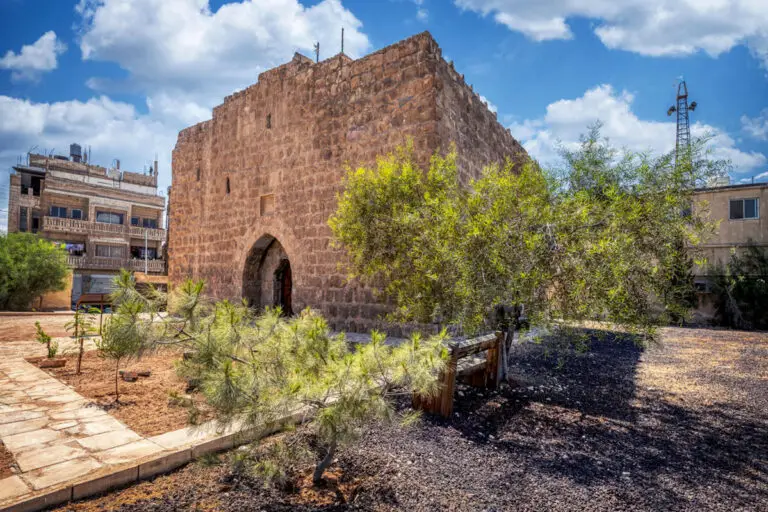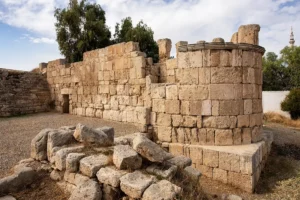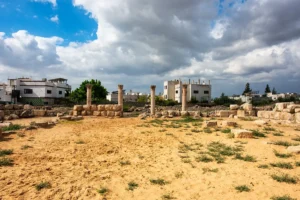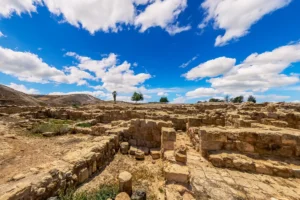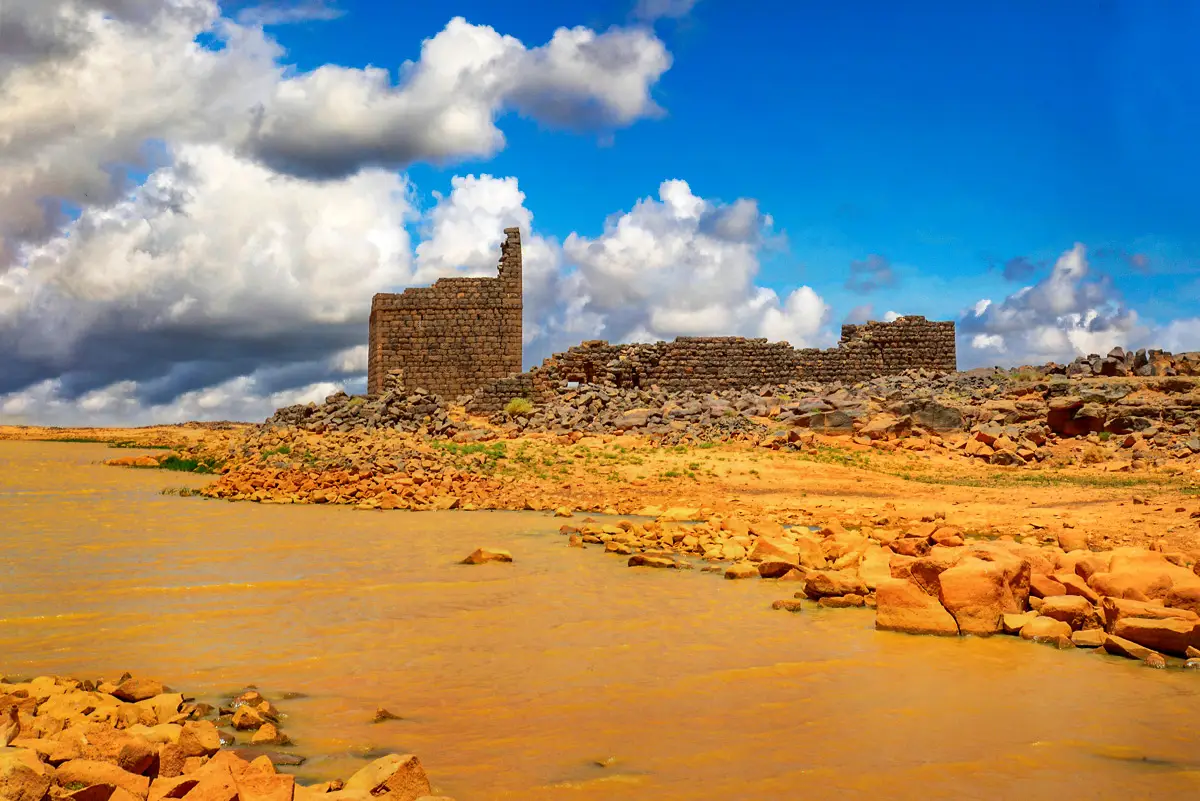












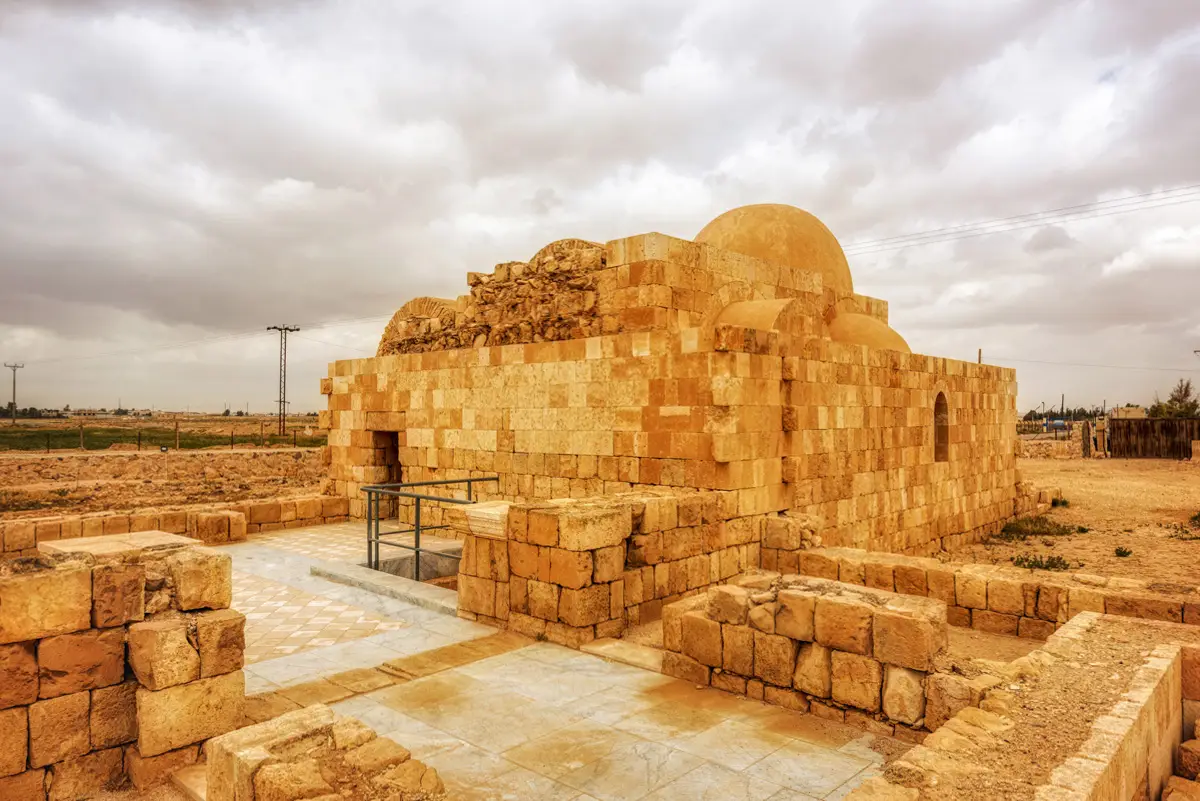

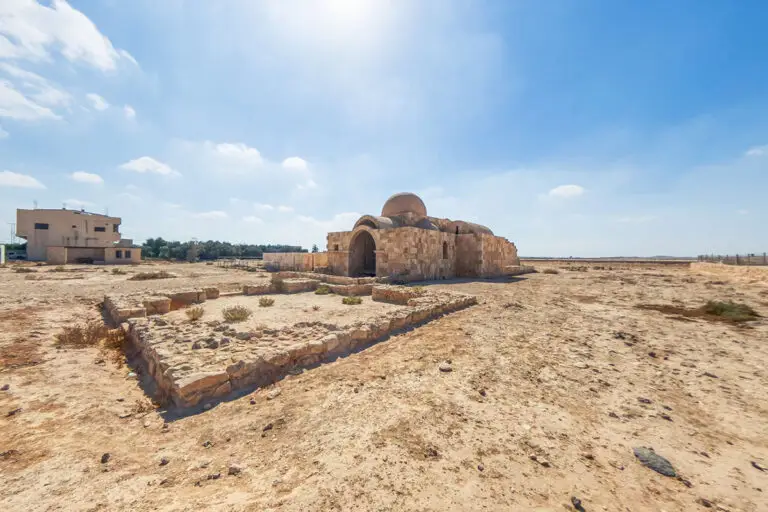


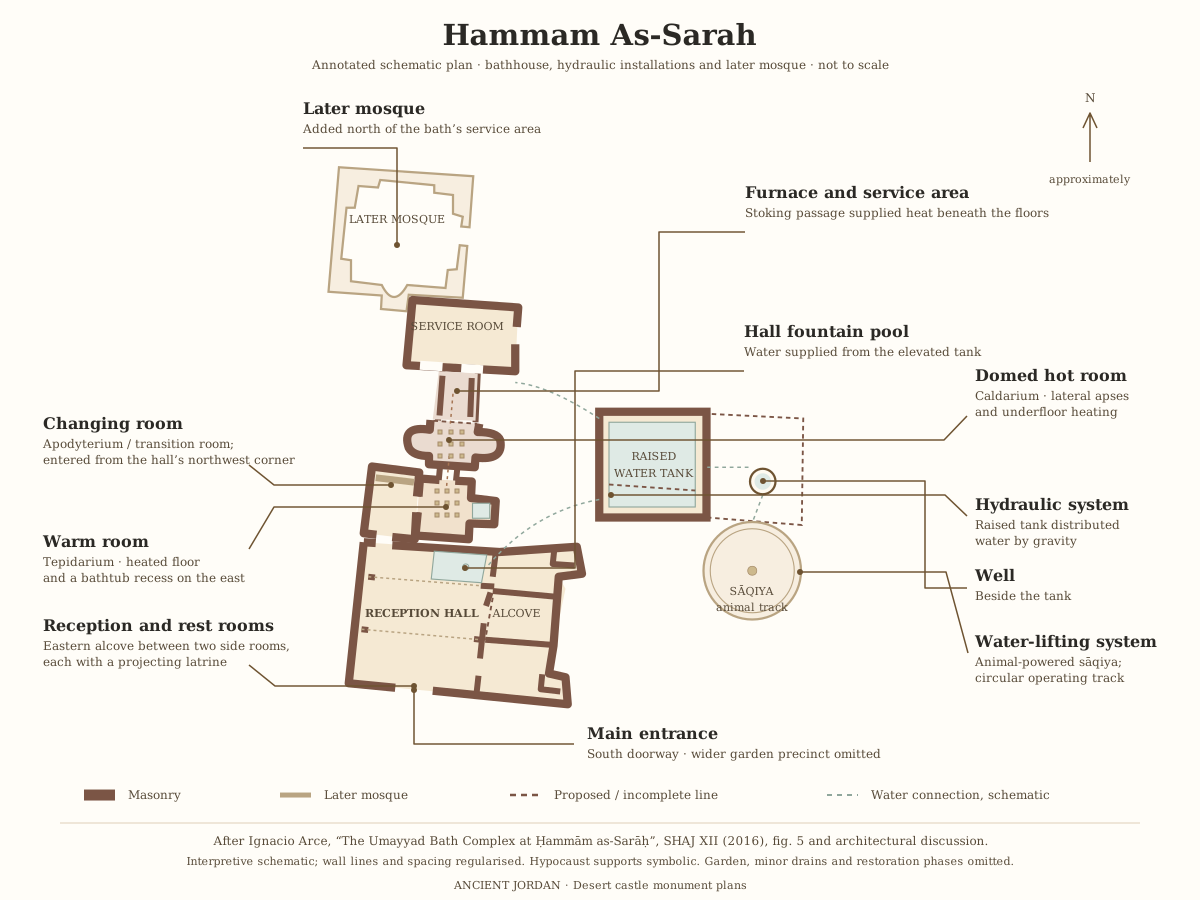
A few kilometres from the palace of Qasr Al-Hallabat, the Umayyads built a bathhouse where guests could be received and bathed in the comfort of a Roman-style bath. Hammam As-Sarah is small, but almost every part of the system survives: reception hall, warm and hot rooms, furnace, and the well and tank that supplied the water.
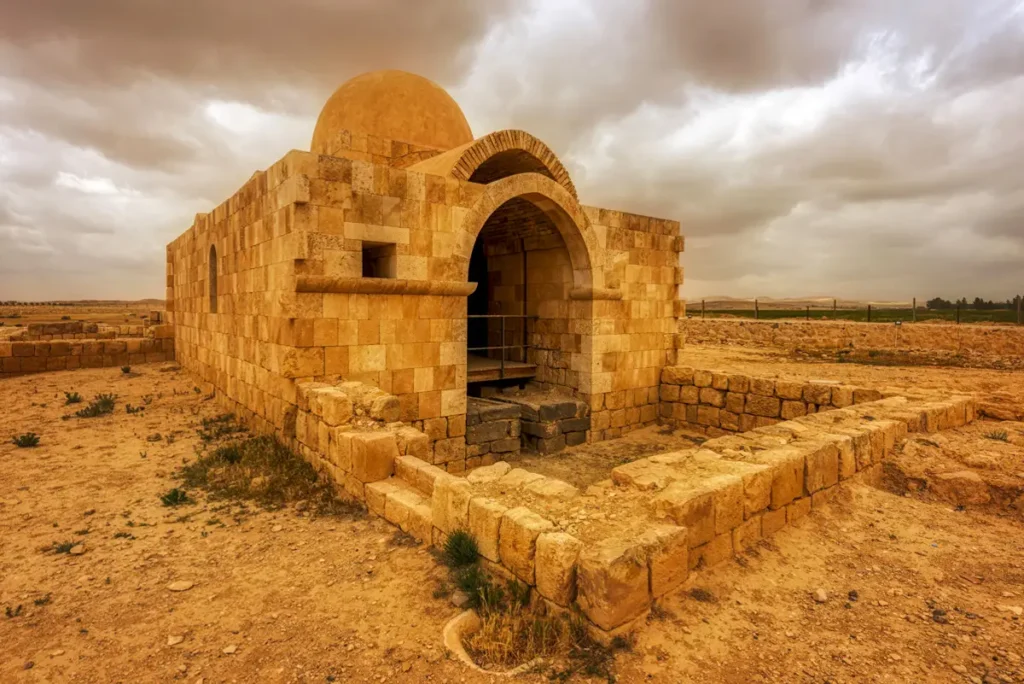
Where Is Hammam As-Sarah?
The bathhouse stands about 3.5 km east of Qasr Al-Hallabat and about 56 km north-east of Amman, in Zarqa Governorate. It belonged to the Hallabat estate, and the two sites are easily seen in one visit.
Historical Context and Origin
Hammam As-Sarah dates from the Umayyad period, in the 8th century AD, but no inscription names its builder. It was part of the estate the Umayyads made of the old fort at Hallabat. The bath was built first; the reception hall was added against it later. Like Qasr Amra, it combines a bath with a hall for receiving guests, a pairing that suited a ruling family who governed through hospitality to tribal leaders. The plan and heating follow Roman bath traditions of the region.
Architectural Design
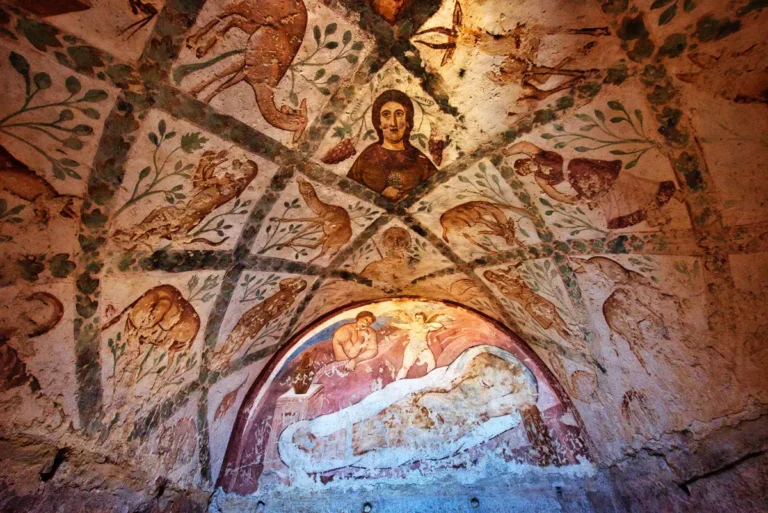
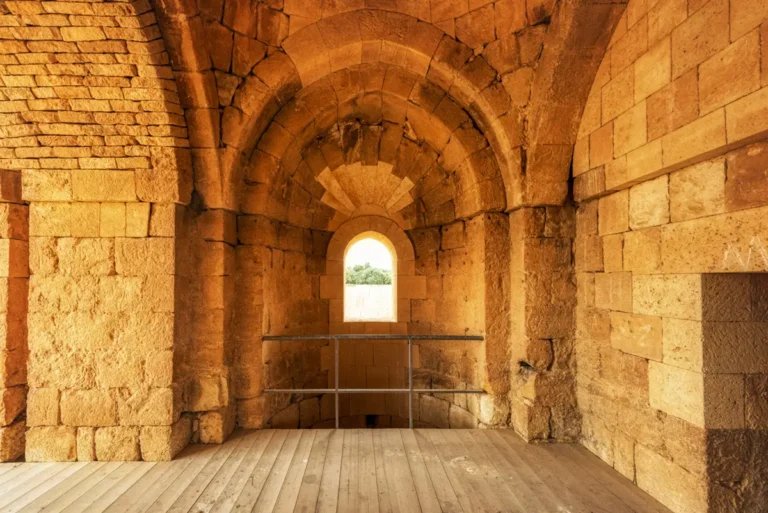
The reception hall, about 8 × 9 m, was covered by three barrel vaults, with an alcove, side rooms and a sunken fountain-pool. Its floor was a chessboard of white and pink limestone tiles framed in marble. From the hall, bathers passed through a changing room into the warm room (tepidarium) and the hot room (caldarium), a cross-shaped space with a dome on pendentives. Traces of wall painting survive on the vaults, and a large red painted inscription on the hall wall is now illegible.
Domed Hot Room
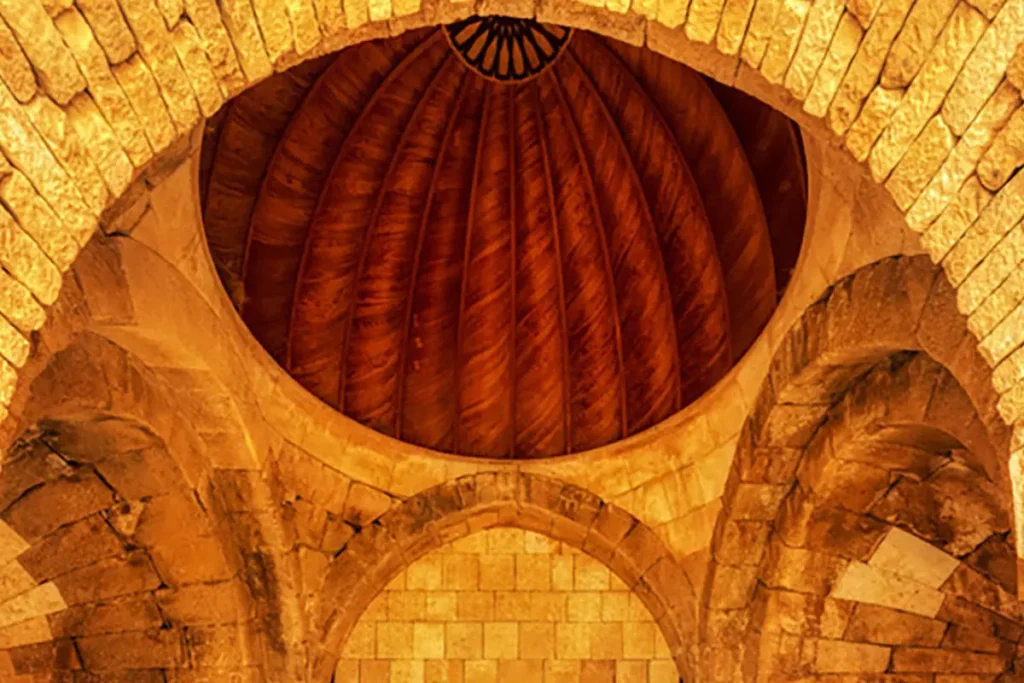
The caldarium is crowned by a dome on pendentives, rebuilt after it fell in the 1960s.
Underfloor Heating
Hot air from the furnace ran under the floors and up through the walls.
Well and Tank
A water wheel lifted water into a raised tank holding about 50 m³.
Reception Hall
Three barrel vaults covered a hall with a fountain-pool for receiving guests.
The painted Kufic inscription
A monumental Arabic inscription painted in red Kufic lettering survives in fragments on the reception hall’s north wall, facing the entrance. It was subsequently concealed behind marble cladding; after the cladding disappeared, the exposed paint deteriorated badly. Frédéric Imbert’s study, 2015
(١) … الله الــ …
(٤) … الله …
(٦) … الملائكة المقربون …
(٧) … الوكيل ؟ … الله …
(١١) … الله …
1. “… God, the …”
4. “… God …”
6. “… the angels brought near [to God] …”
7. “… the steward/guardian (?) … God …”
11. “… God …”
Researchers documented eleven lines, covering approximately 3.45 × 1.25 metres. Most of the wording is now unreadable. Its importance lies partly in its technique: it is a rare example of large painted Arabic lettering from the Umayyad period, comparable with inscriptions at Qusayr Amra and Qasr Kharana. Published archaeological discussion, p. 336, note 20
Only fragments can be transcribed securely. The readable passages identified by Frédéric Imbert are rendered in modern Arabic spelling, not as a facsimile of the original Kufic lettering. The numbers are the original line numbers. Ellipses indicate unreadable or missing text; ? marks an uncertain reading.
These are isolated passages, not consecutive sentences. The intervening lines cannot be translated reliably. (Imbert, 2015, p. 325)
Imbert proposes that the opening contained the basmala: [بسم] الله الــ[رحمن الرحيم], “[In the name of] God, the [Compassionate, the Merciful].” The brackets identify restored wording.
The fragments suggest religious invocations. “The angels brought near” has a Qur’anic parallel, but Imbert favours a series of prayers over a continuous Qur’anic quotation. The uncertain al-wakīl could refer to a steward or guardian; alternatively, its religious context may evoke entrusting oneself to God. Neither interpretation is secure. (Imbert, p. 326)
No readable patron’s name or construction date can be supplied. Its principal significance is its rare monumental painted Arabic script, rather than a recoverable foundation statement.
Water and Heat: How the Bath Worked
Behind the hot room, a furnace sent hot air under floors raised on small stone pillars (a hypocaust) and up through channels in the walls. A tank above the furnace probably produced steam. East of the bath, a well at least 14 m deep fed a water wheel (saqiya) that lifted water into a raised square tank of about 50 m³, from which clay pipes carried it by gravity to the bath, the fountain and a walled garden about 90 m square.
Destruction, Rediscovery, and Restoration
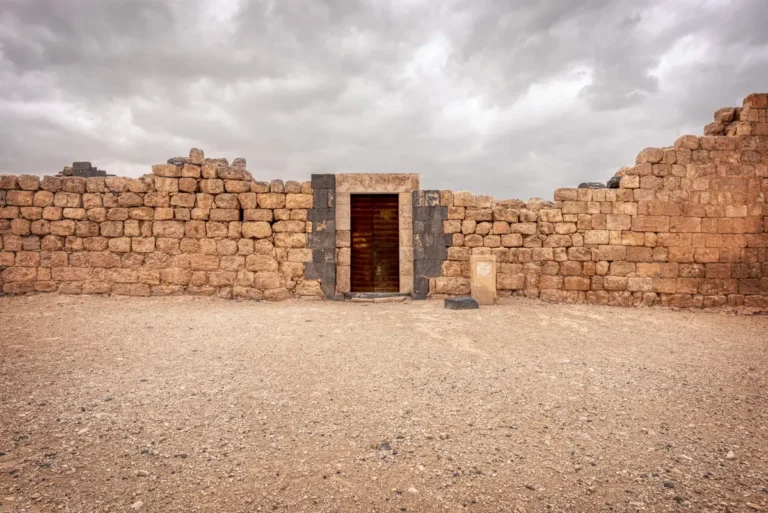
Howard Crosby Butler recorded the building in 1905, and K. A. C. Creswell photographed it, still well preserved, in 1926. From the 1950s its dressed stones were heavily looted, and the dome fell in the 1960s. The Department of Antiquities excavated it and carried out an emergency restoration in 1974–75 with cement mortar. A Spanish mission led by Ignacio Arce excavated and restored it again in 2010–13 with lime mortar, and in 2019–21 rebuilt the entrance gate from its original stones.
Visiting Hammam As-Sarah Today
Entry is free. Allow about 15 minutes to walk through the hall and bathing rooms and to see the well and tank outside. Combine it with Qasr Al-Hallabat. See our Hammam As-Sarah travel guide for practical details.
Further reading: Arce, The Umayyad Bath Complex at Hammam as-Sarah (SHAJ XII); Archnet — Hammam al-Sarah.