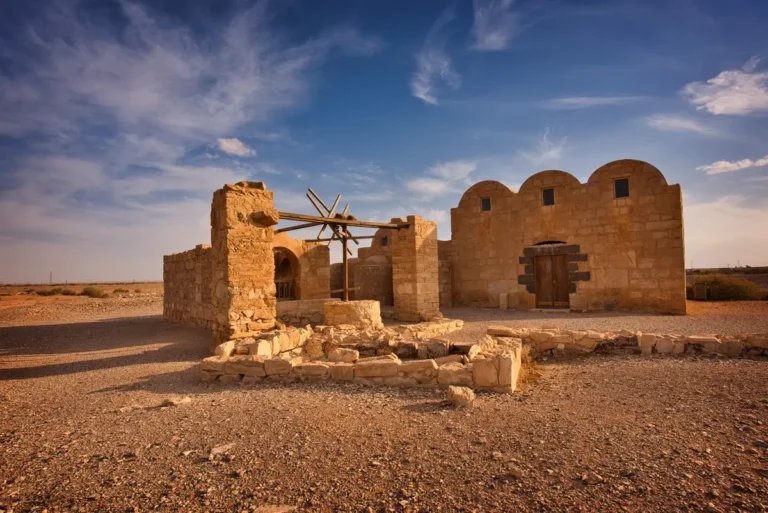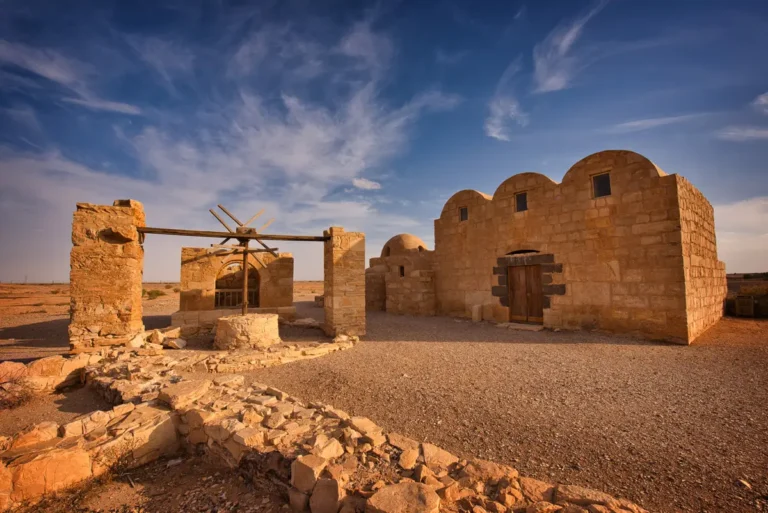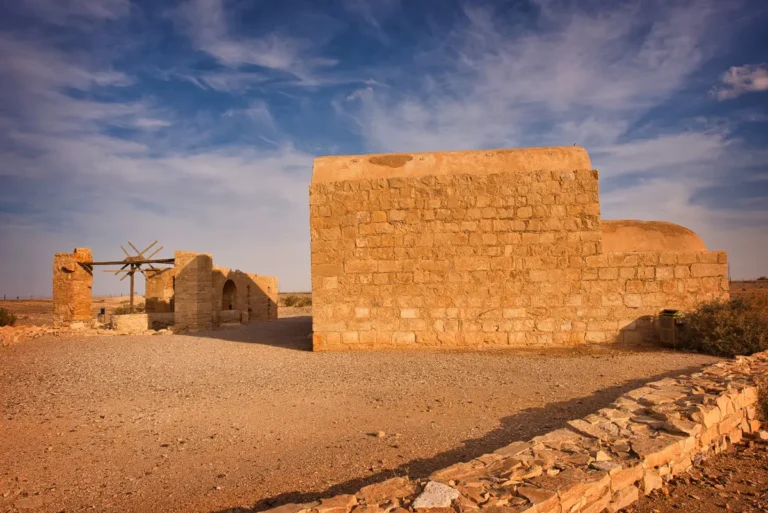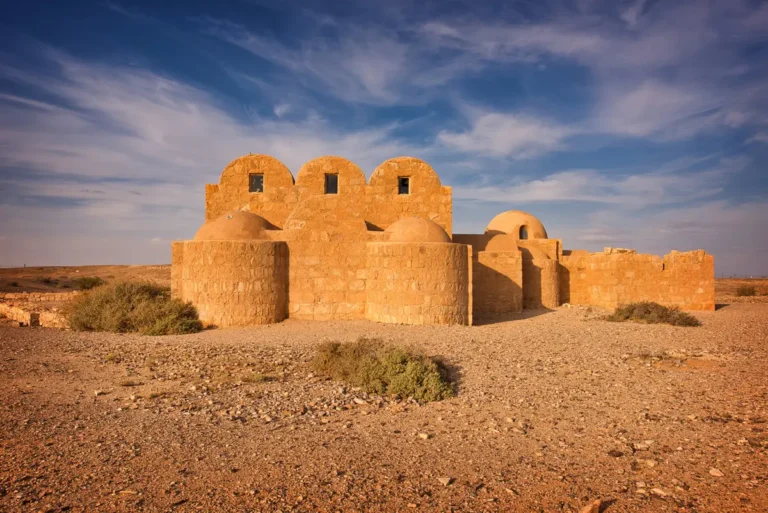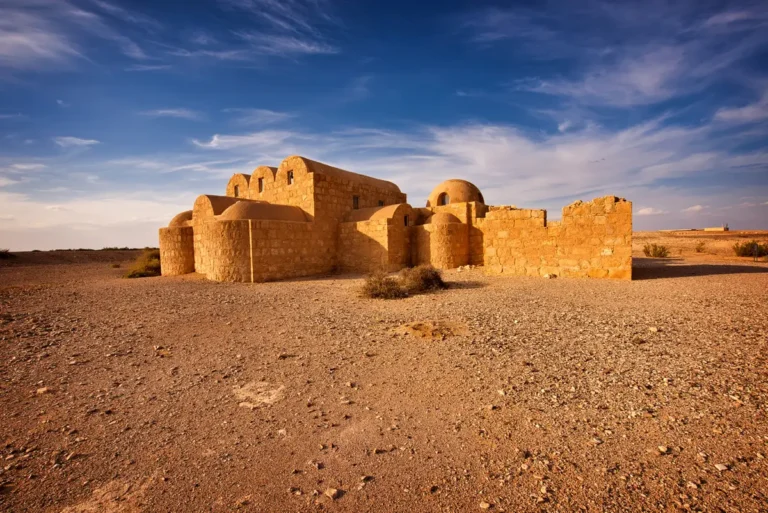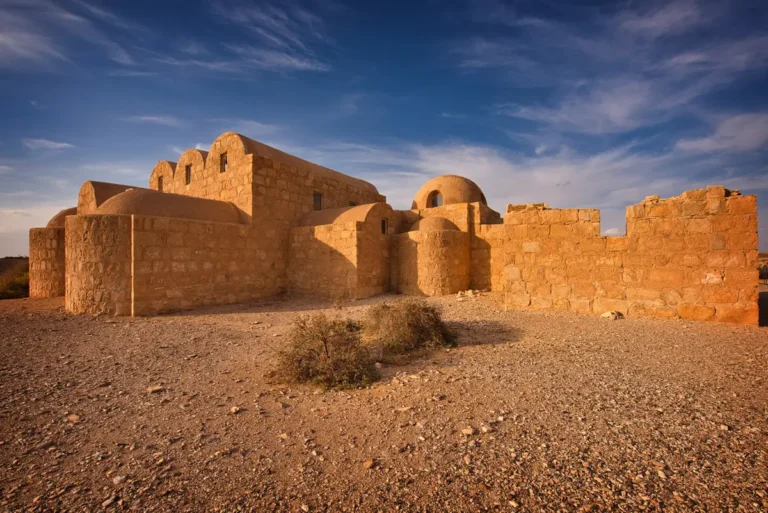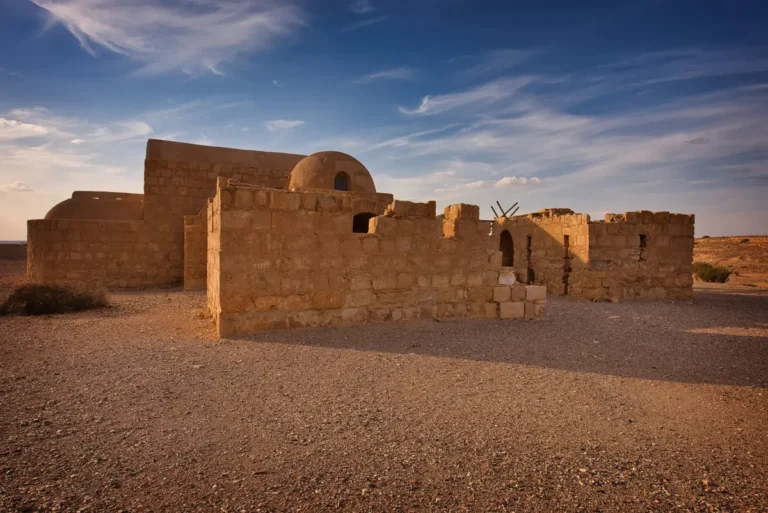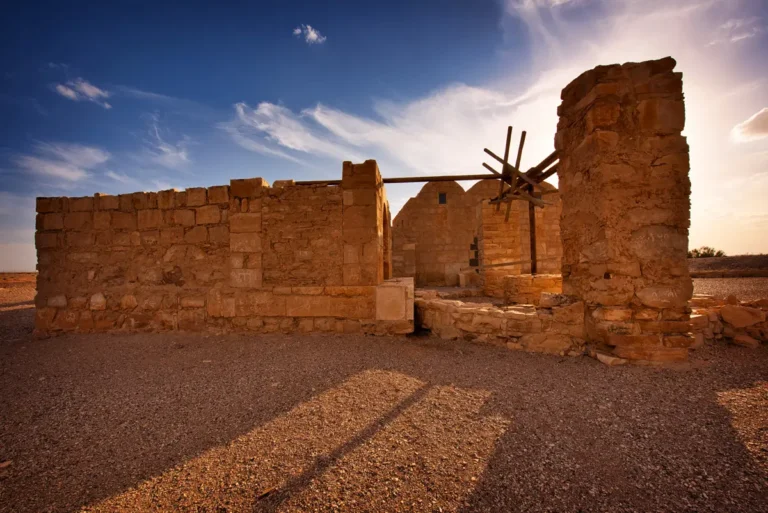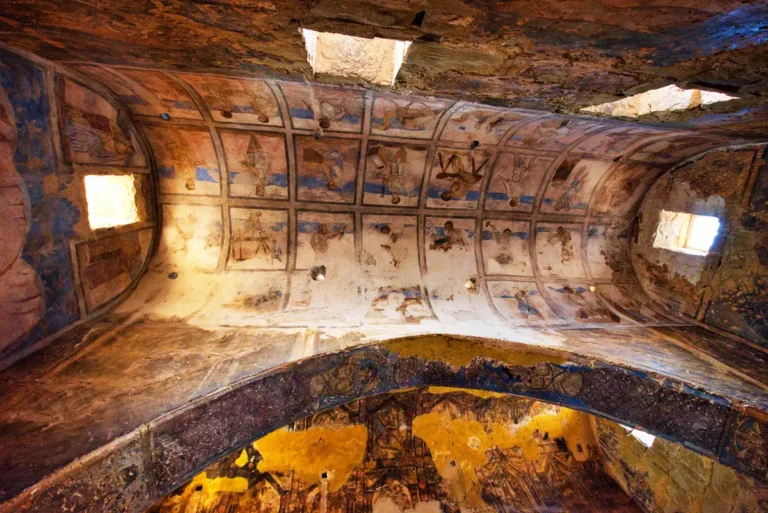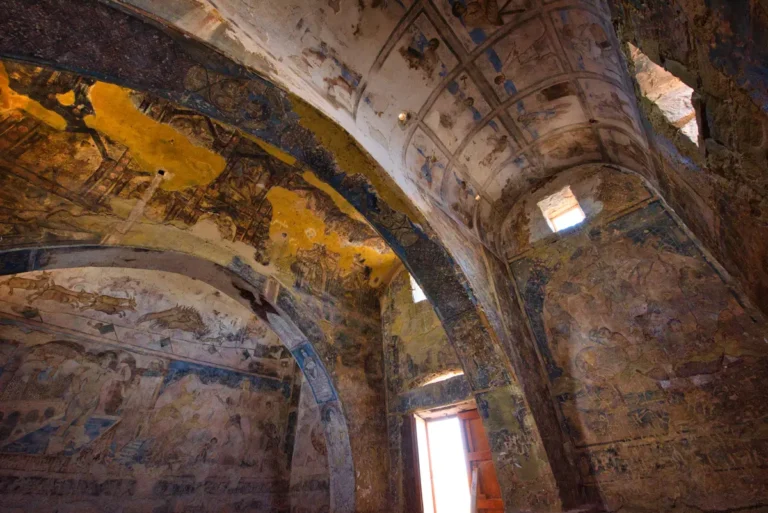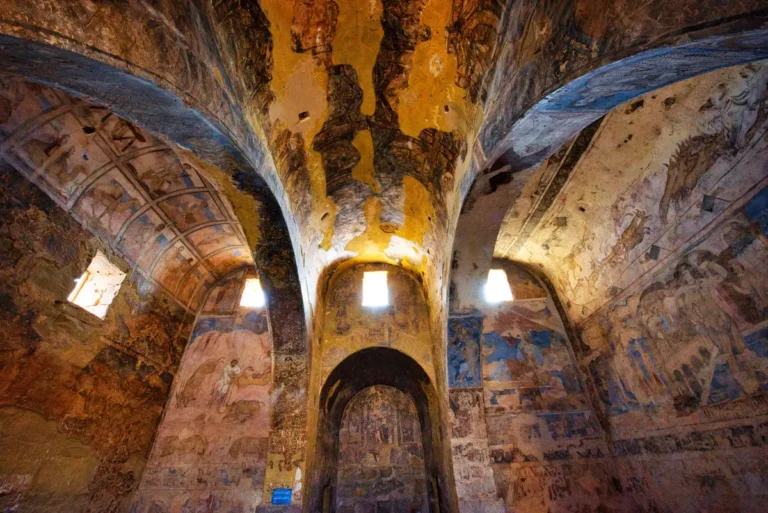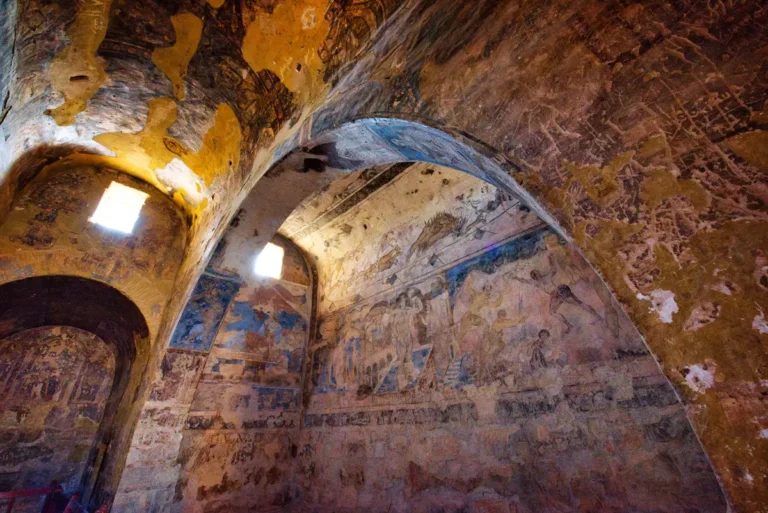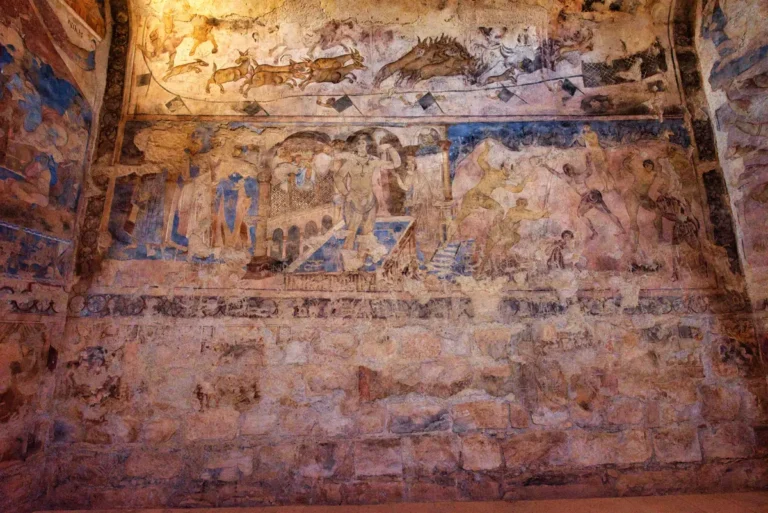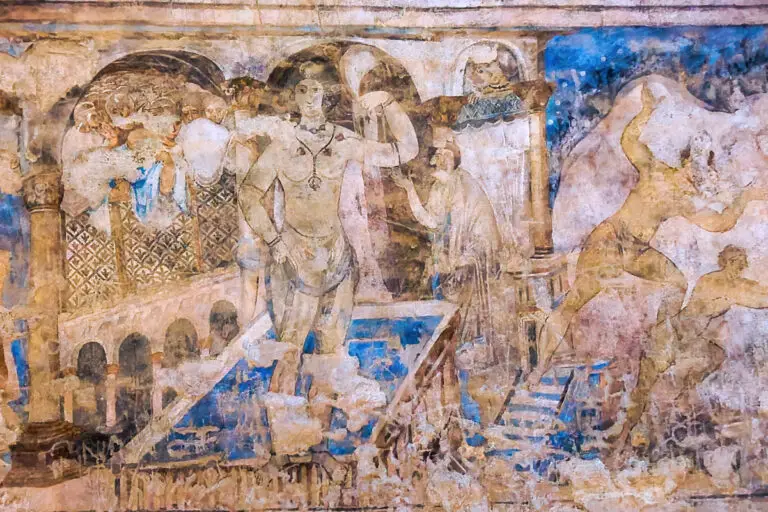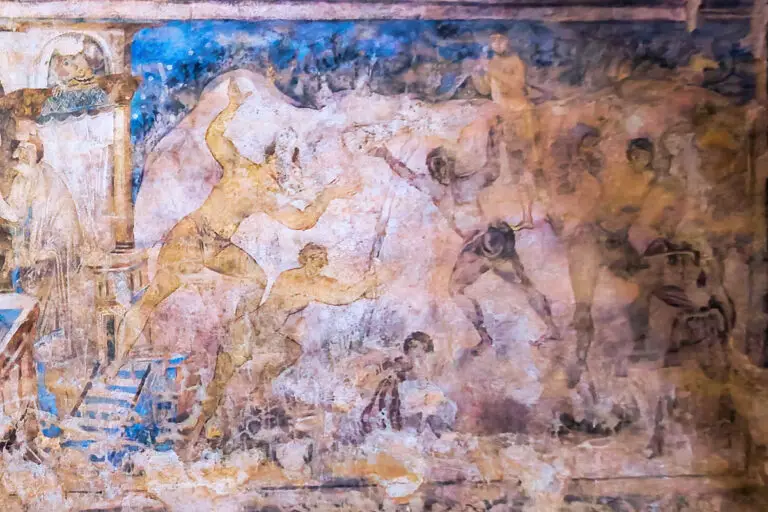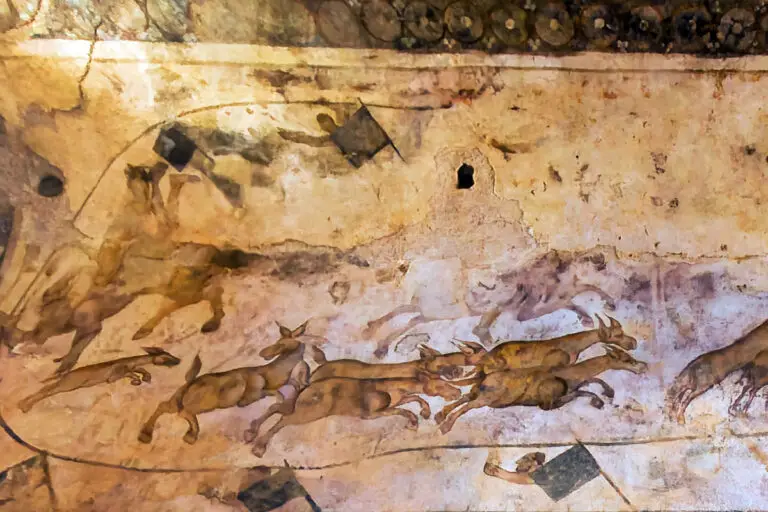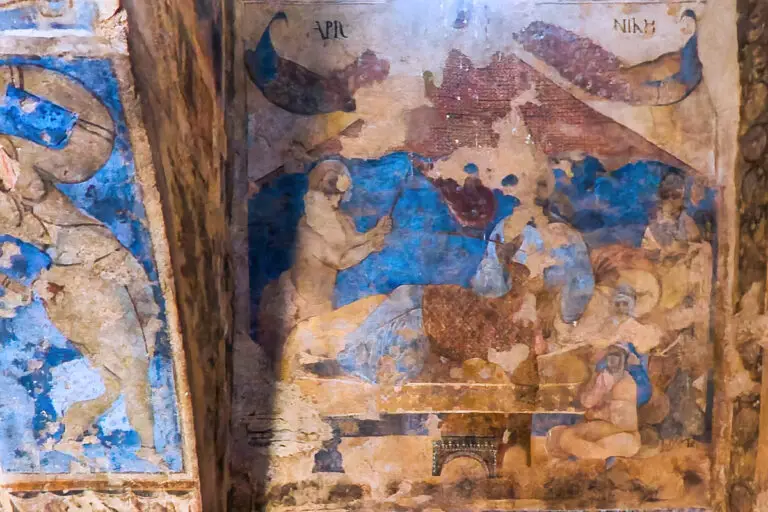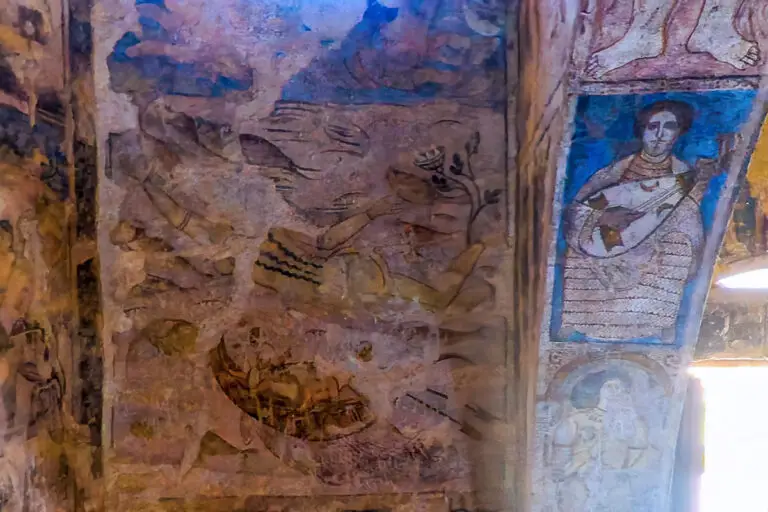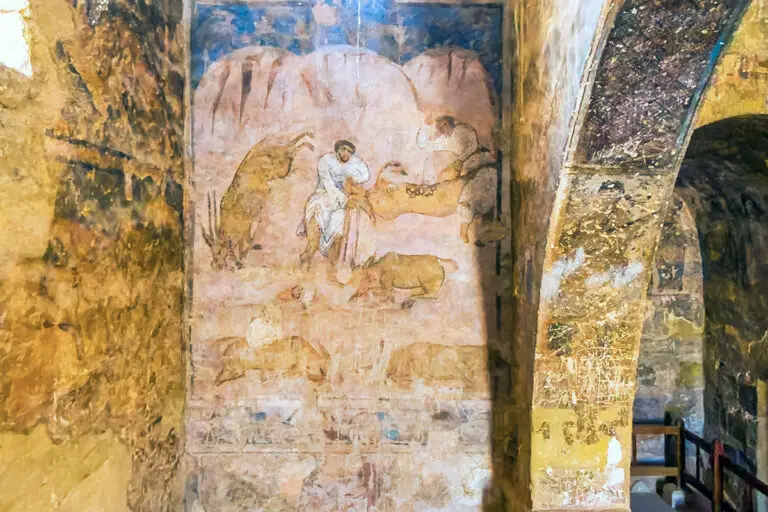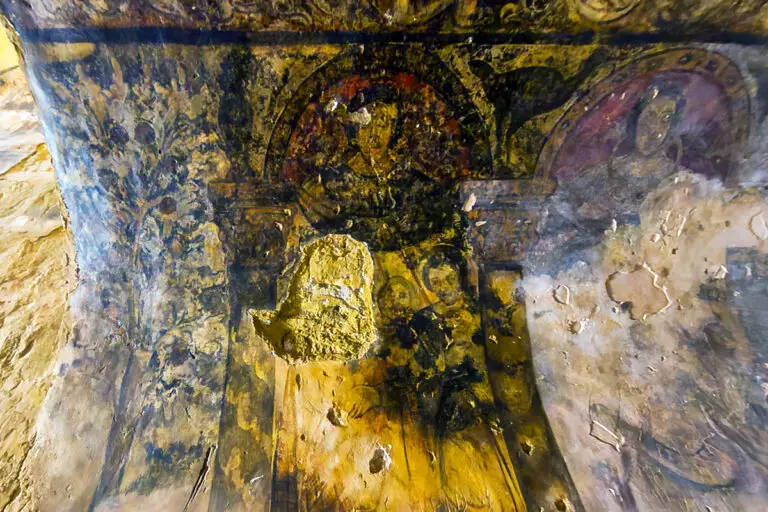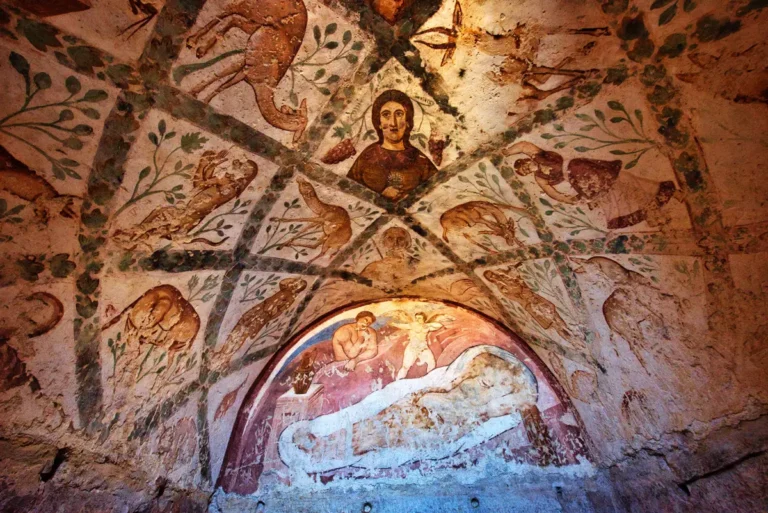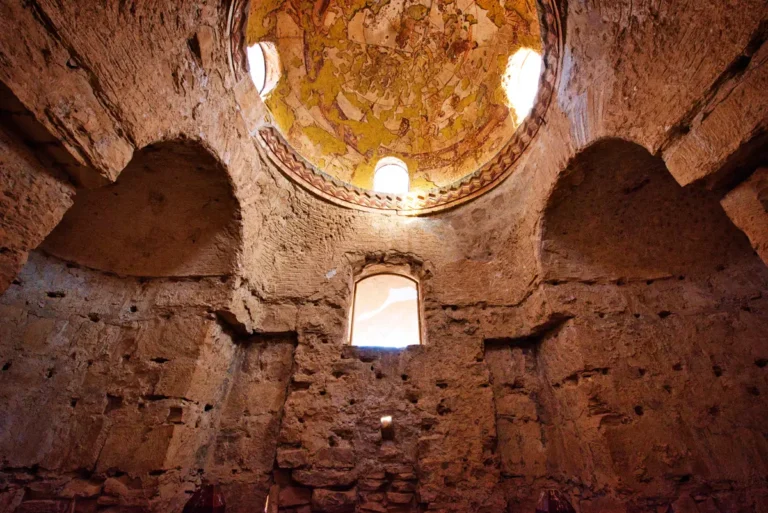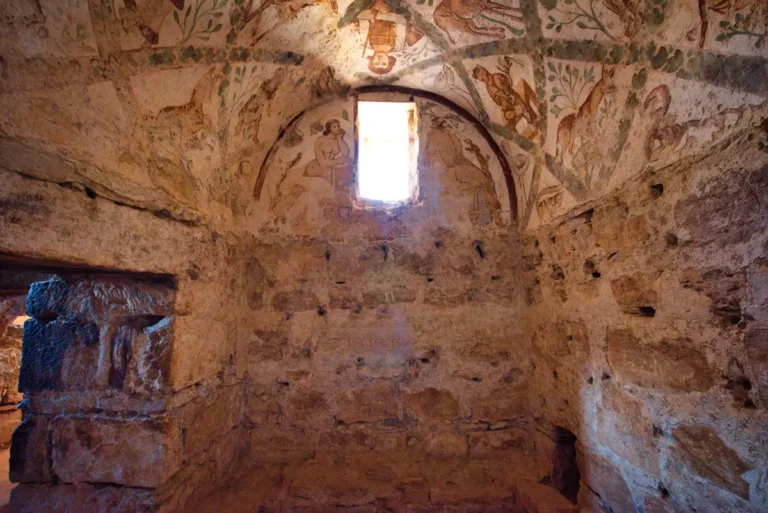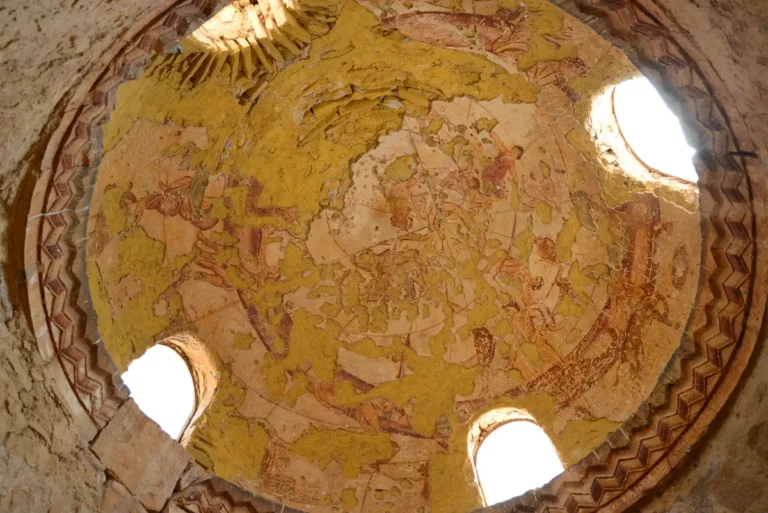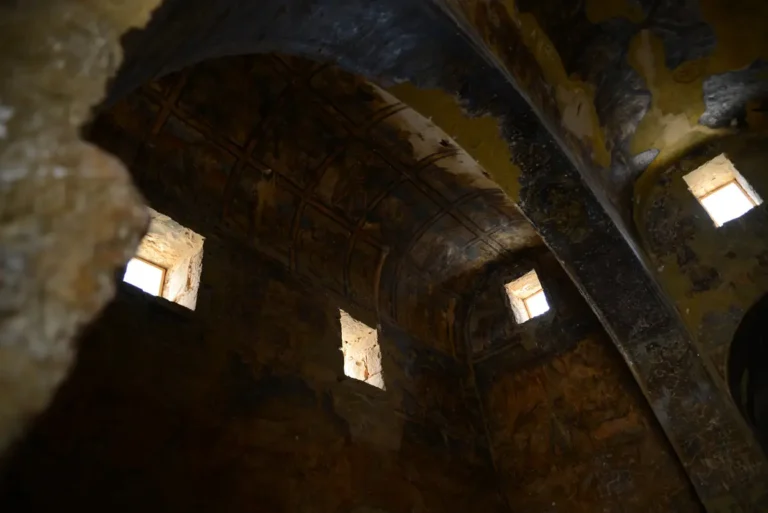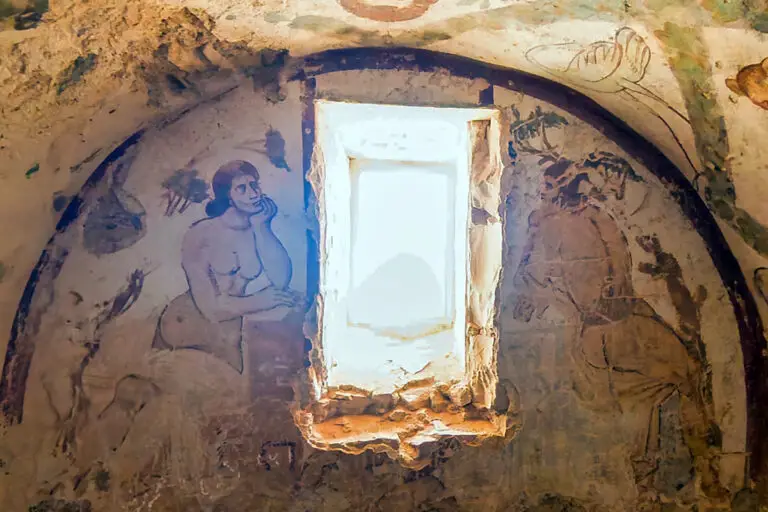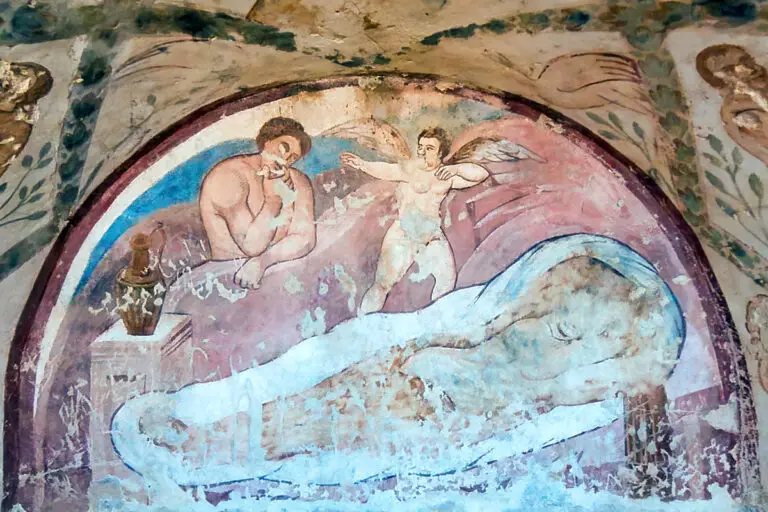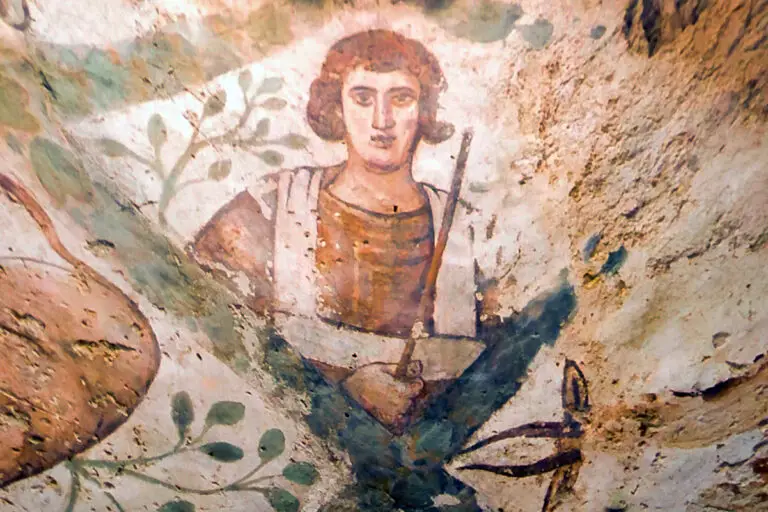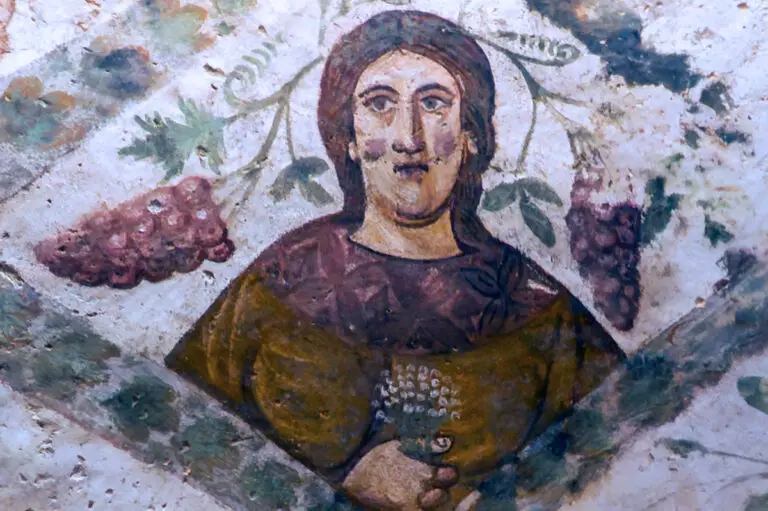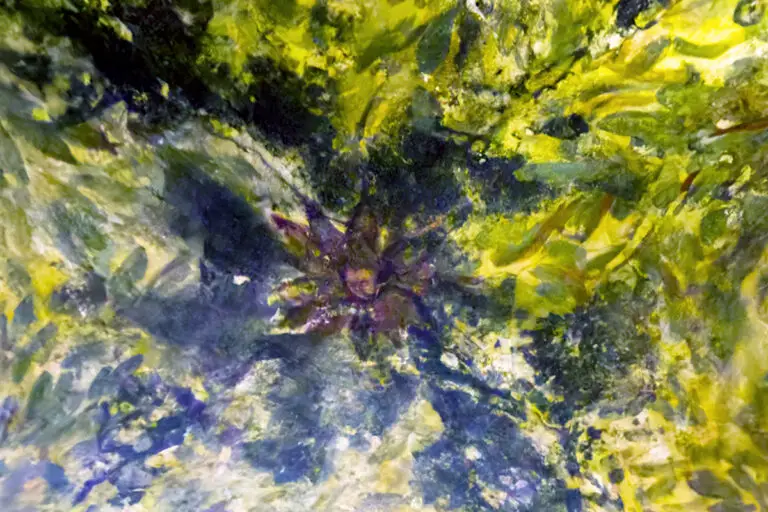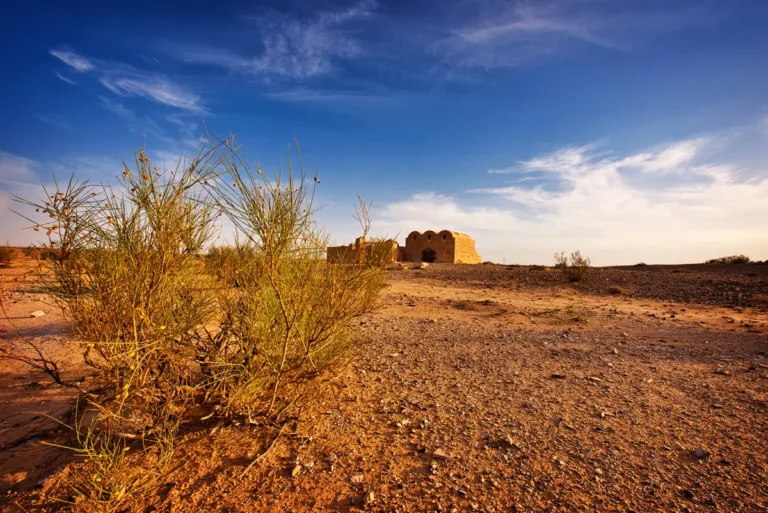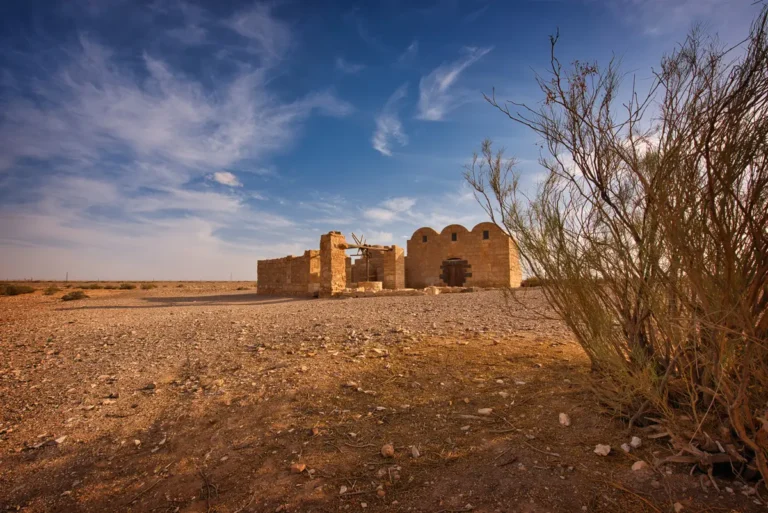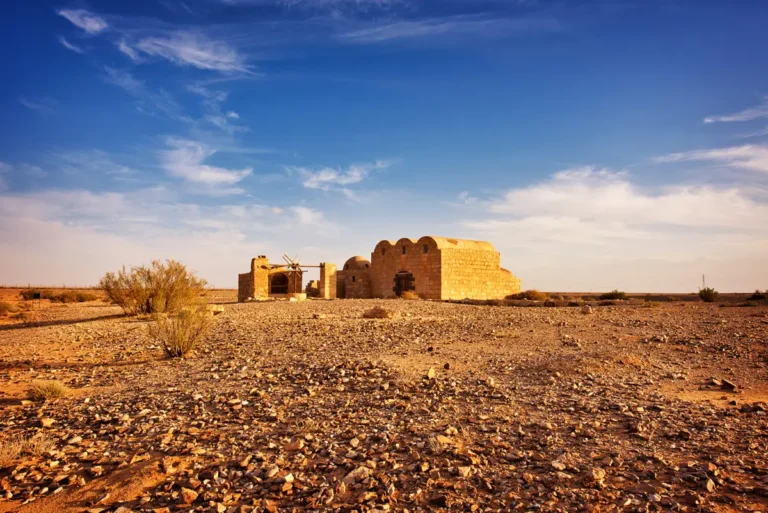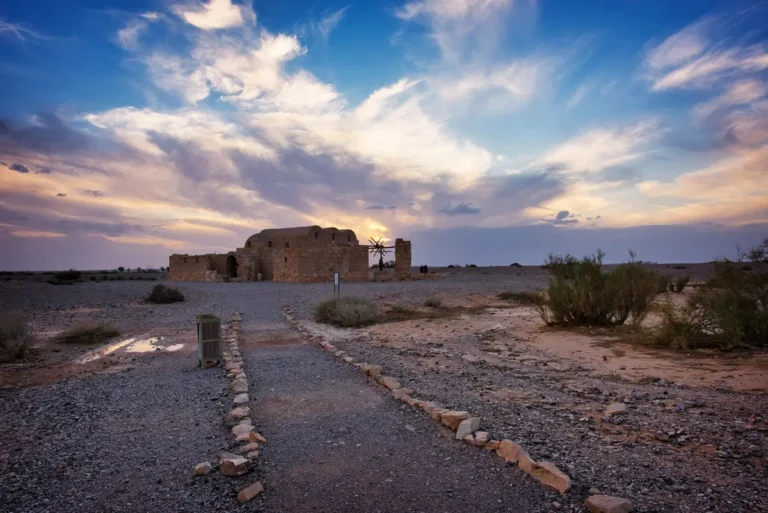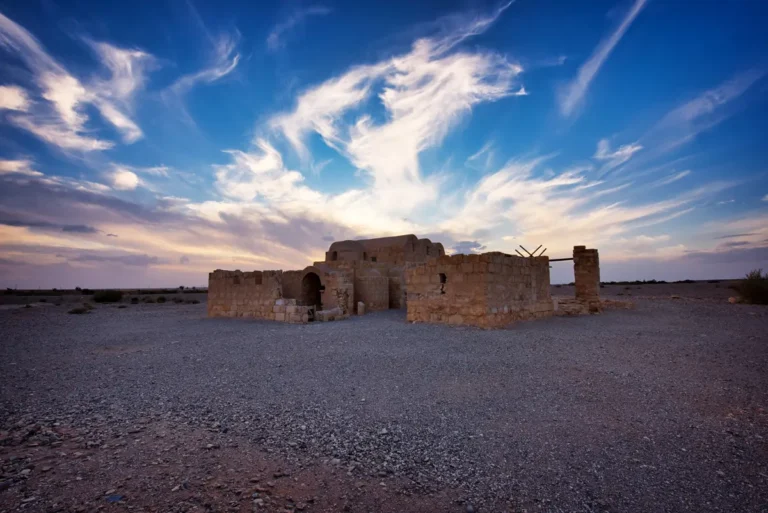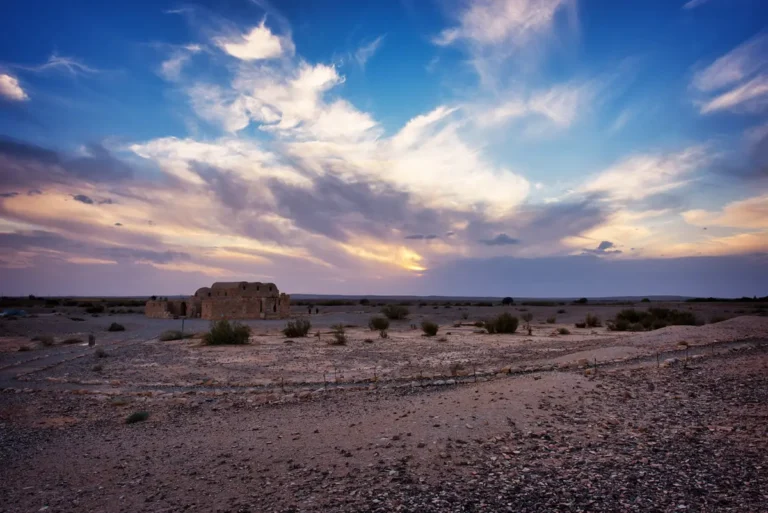
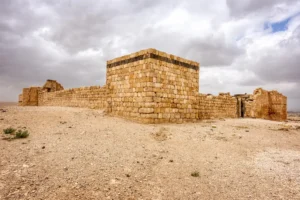
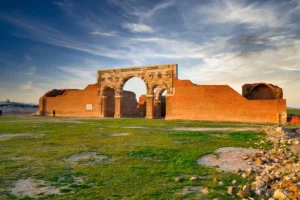
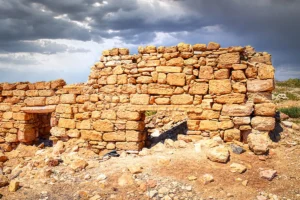
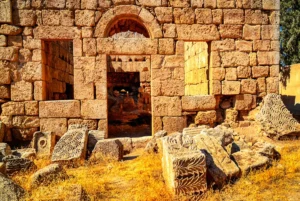
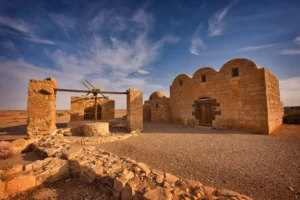
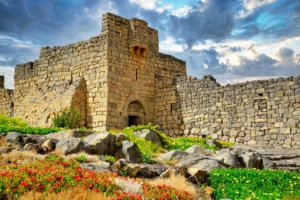
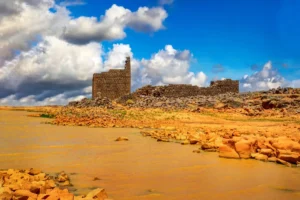
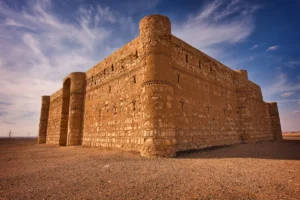
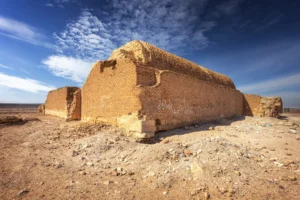
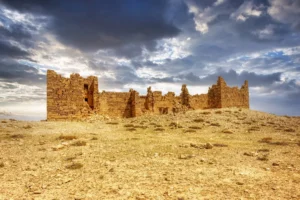
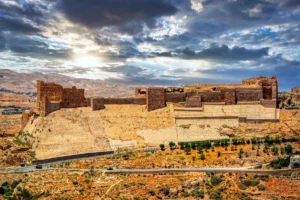
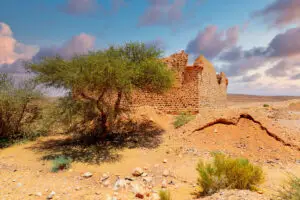
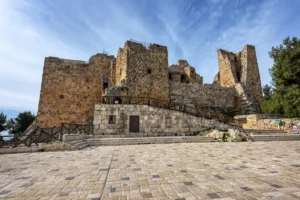
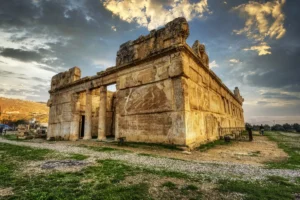
From outside, Qasr Amra gives little away. Its low stone walls and rounded roofs rise modestly from the landscape of Jordan’s Eastern Desert. Step inside, however, and the building opens onto an extraordinary painted world: hunters and animals, courtly figures and bathing scenes, and, overhead in a small domed chamber, a vision of the heavens.
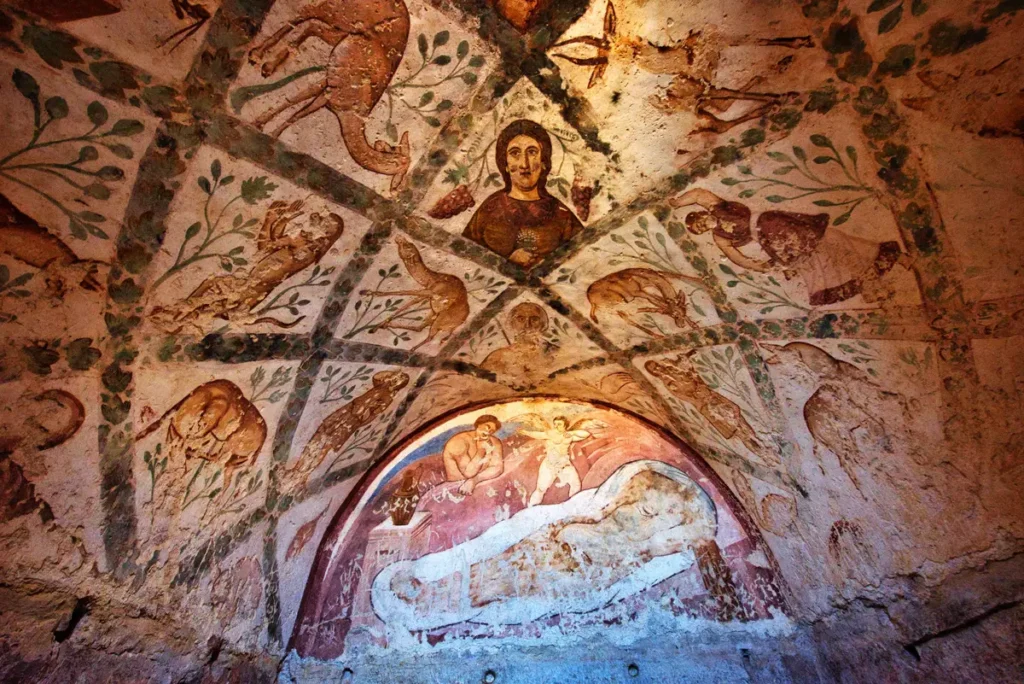
Also known as Qusayr ‘Amra or Quseir Amra, this eighth-century Umayyad monument preserves a remarkable encounter between architecture, art, and princely life. Its reception hall and baths formed part of a larger establishment whose surviving remains extend beyond the familiar painted building.
Recognised as a UNESCO World Heritage Site in 1985, Amra rewards close attention. Its importance lies as much in a fragment of lettering or a painted gesture as in the sweep of a decorated ceiling.
AT A GLANCE
- Location: Beside Wadi al-Butum, near Highway 40 between Amman and Azraq
- Distance from Amman: Approximately 75 km, depending on your route
- Historical period: Umayyad, eighth century CE
- Patron: Prince al-Walid ibn Yazid, the future caliph al-Walid II
- Principal surviving building: A painted reception hall and bath complex
- Main highlights: Six Kings painting, princely imagery, bathing scenes, zodiac dome, and water-supply system
- World Heritage status: Inscribed in 1985
- Suggested visit: 30–40 minutes for the paintings, architecture, and exterior
- Jordan Pass: Included
FIRST IMPRESSIONS
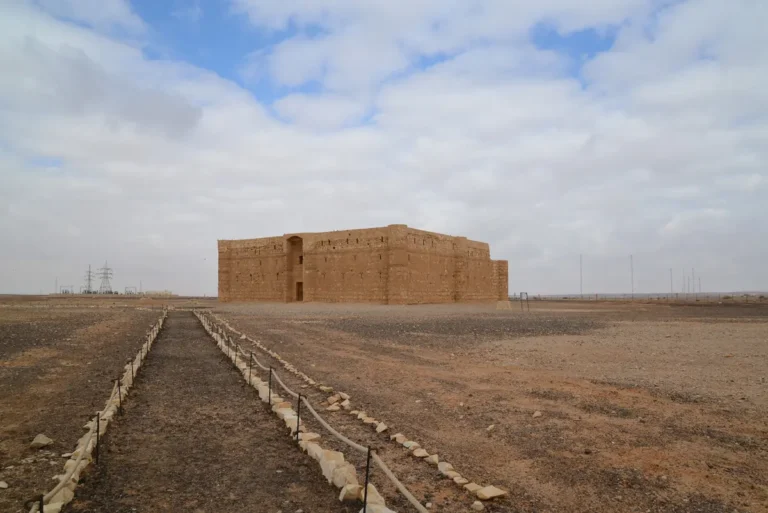
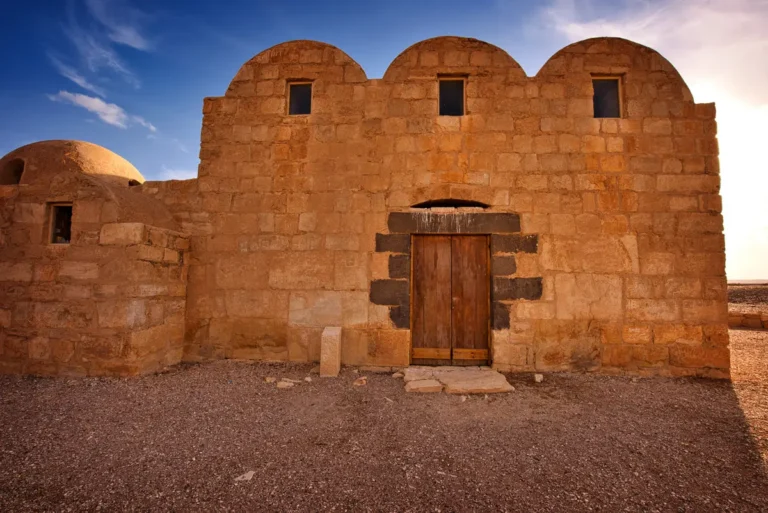
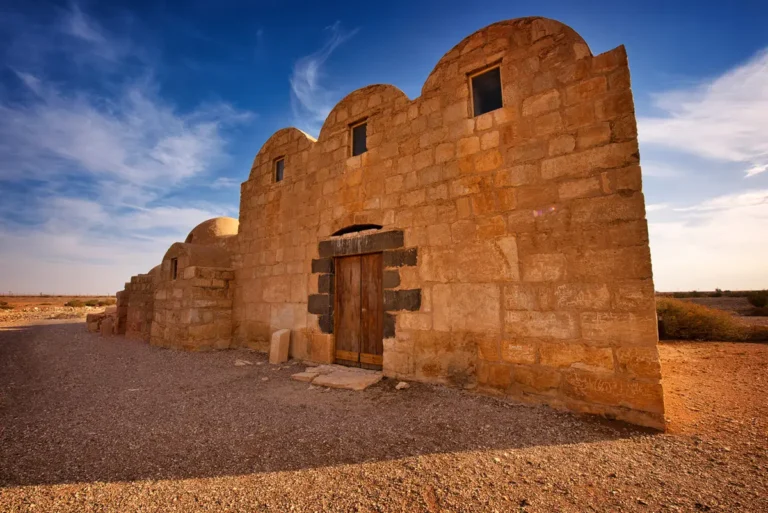
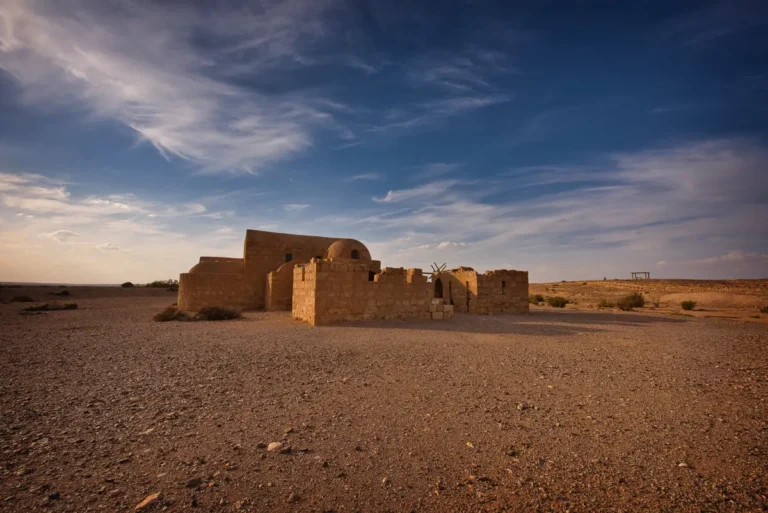
Amra’s scale can come as a surprise. The word “castle” prepares the imagination for towers, battlements, and commanding walls. Here, the eye follows a different outline: a cluster of vaults, a dome, and an entrance leading into a comparatively intimate interior.
Pause before going inside. The shapes visible above the walls correspond to spaces you will soon enter. Looking at them now makes the arrangement easier to understand later, when paintings compete for your attention.
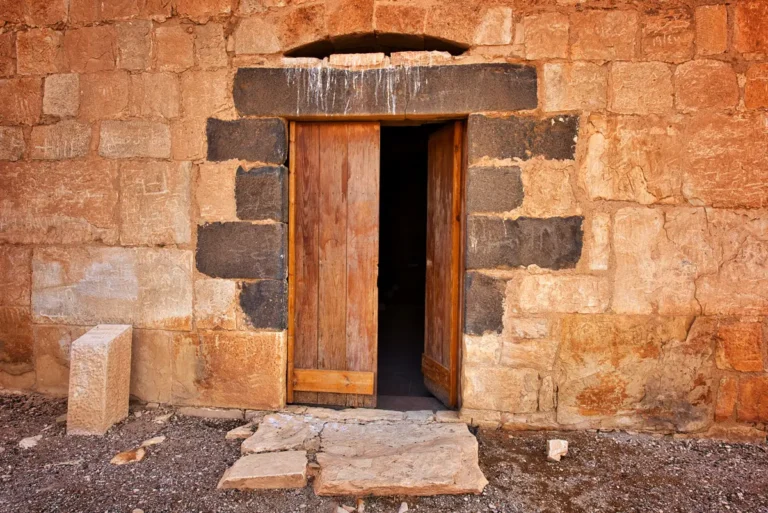
At the threshold, allow your eyes to adjust. Resist the impulse to identify every figure immediately. Begin with the distribution of colour across the walls, then follow the paintings upwards into the vaults. Some scenes remain relatively legible; others emerge only as fragments.
The experience depends on this change of pace. Amra is a small building with an unusually large amount to see.
- Qasr Amra - Reception Hall 3D Panorama
HISTORICAL CONTEXT AND ORIGIN
Qasr Amra belongs to the Umayyad world of the eighth century, when rulers based in Damascus maintained estates and establishments across the surrounding countryside. The buildings now called Jordan’s Desert Castles differed considerably in size and purpose. Amra’s painted baths were one component of a wider complex that included other structures and hydraulic installations.
Its patronage became much clearer through conservation. In May 2012, cleaning in the western aisle of the reception hall revealed an Arabic inscription naming al-Walid ibn Yazid. He would later rule as al-Walid II, becoming caliph in 743 CE. This discovery supplied direct evidence for an attribution that had previously depended heavily on interpretation.
The monument is generally associated with his years as a prince, before his accession. Conservation specialist Gaetano Palumbo proposes a likely construction period between approximately 730 and 743 CE. The safest description is therefore an eighth-century establishment commissioned by the future al-Walid II, with its exact building date still open to refinement.
This distinction matters: al-Walid II and al-Walid I were different rulers. Older accounts attributing Amra to al-Walid I do not incorporate the full significance of the newly legible inscription.
WHERE IS IT
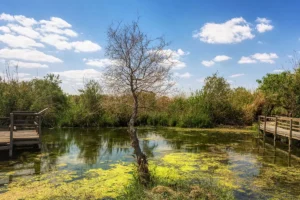
Qasr Amra lies approximately 75 kilometres east of Amman, near the highway leading towards Azraq. It stands beside Wadi al-Butum, a seasonal watercourse whose name refers to the wild pistachio, or terebinth, trees associated with the valley.
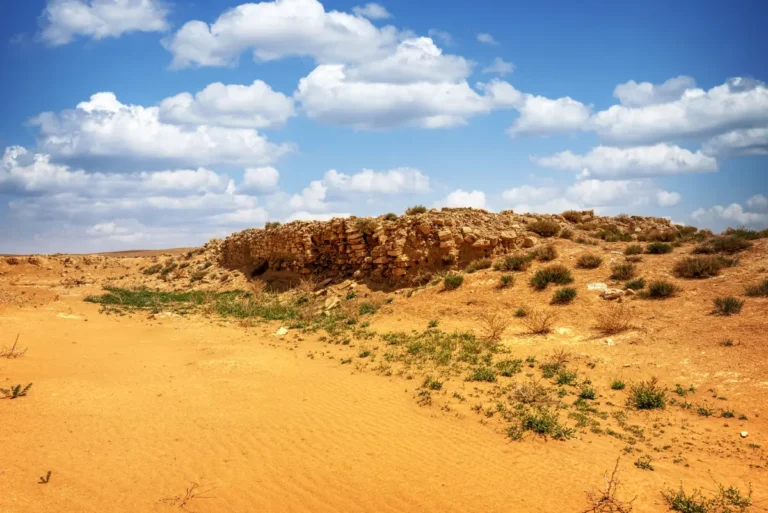
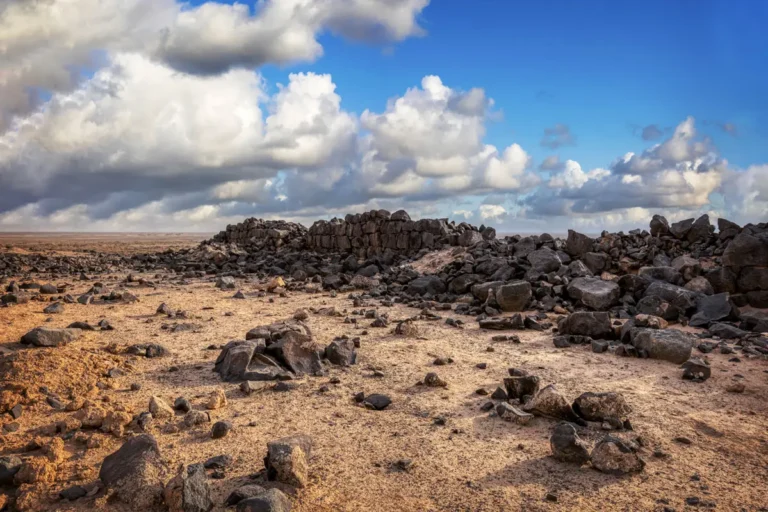
The site management plan describes an archaeological landscape extending well beyond the baths, with remains distributed along the wadi. Seen in this setting, Amra becomes more than an isolated building: its position connects architecture with water, vegetation, and the resources needed to sustain an estate.
For a visit from Amman, allow roughly one and a half to two hours each way as a planning estimate, depending on traffic and your starting point.
The site combines naturally with Qasr Kharana and Qasr Azraq. Give the multi-site excursion a full day so that Amra’s paintings receive more than a hurried glance.
WHAT HAPPENED HERE?
Bathing was central to Amra’s design, but the reception hall points towards a broader social setting. A prince could receive guests, offer hospitality, and conduct conversations within surroundings that expressed his status.
Scholars interpret establishments of this kind partly in relation to Umayyad contacts with local tribal leaders. Leisure and political relationships could occupy the same spaces. At Amra, however, no surviving visitor list or account allows us to reconstruct a particular reception. The building provides a setting for such encounters; the details remain beyond reach.
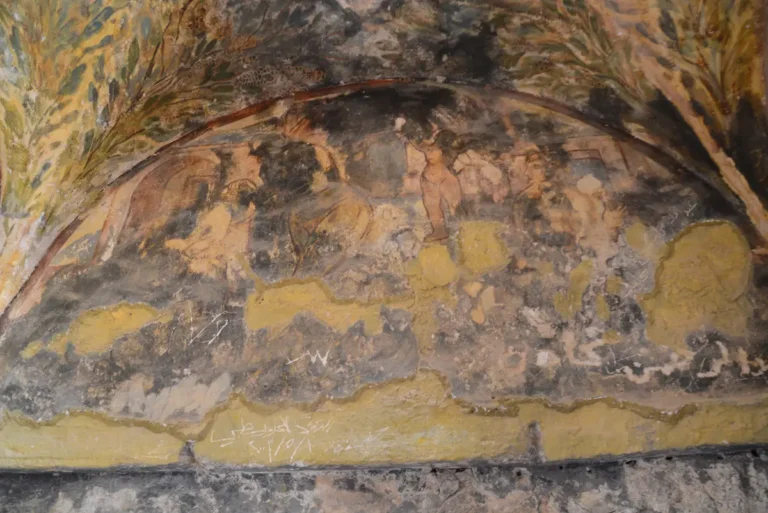
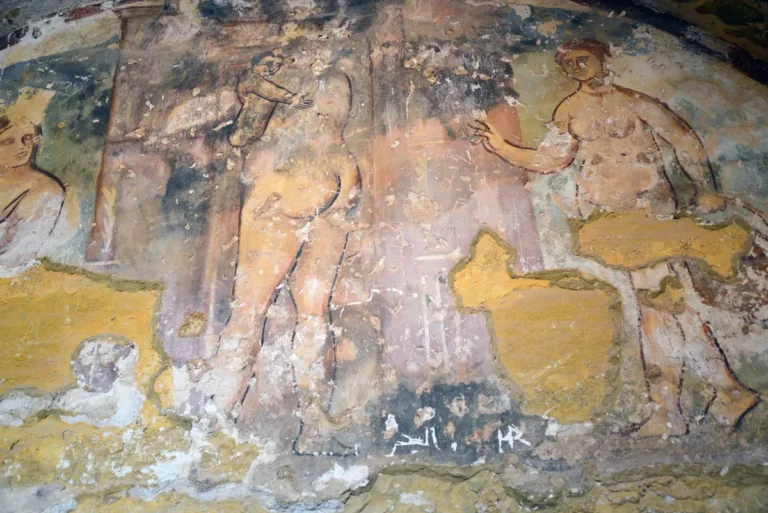
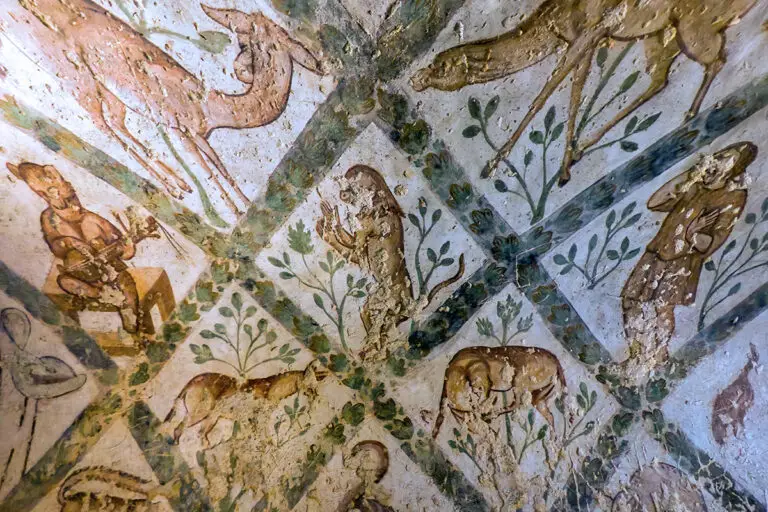
The paintings widen the picture. They include hunting, bathing, animals, crafts, and courtly imagery. Together, these subjects suggest the activities and ambitions valued within a princely environment. They should not all be read as literal records of events that occurred here.
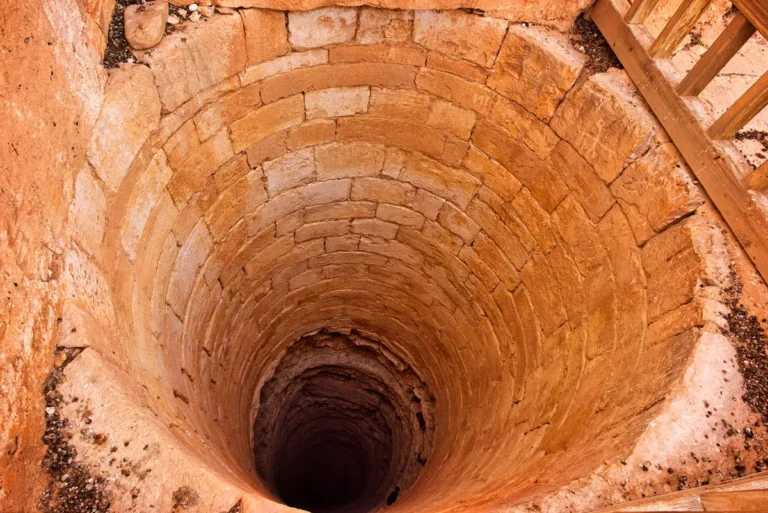
Imagine the practical demands behind the experience: water had to be raised and distributed, fuel supplied, and heated rooms maintained. The surviving service installations offer an essential counterpart to the painted world of leisure.
ARCHITECTURAL DESIGN AND FEATURES
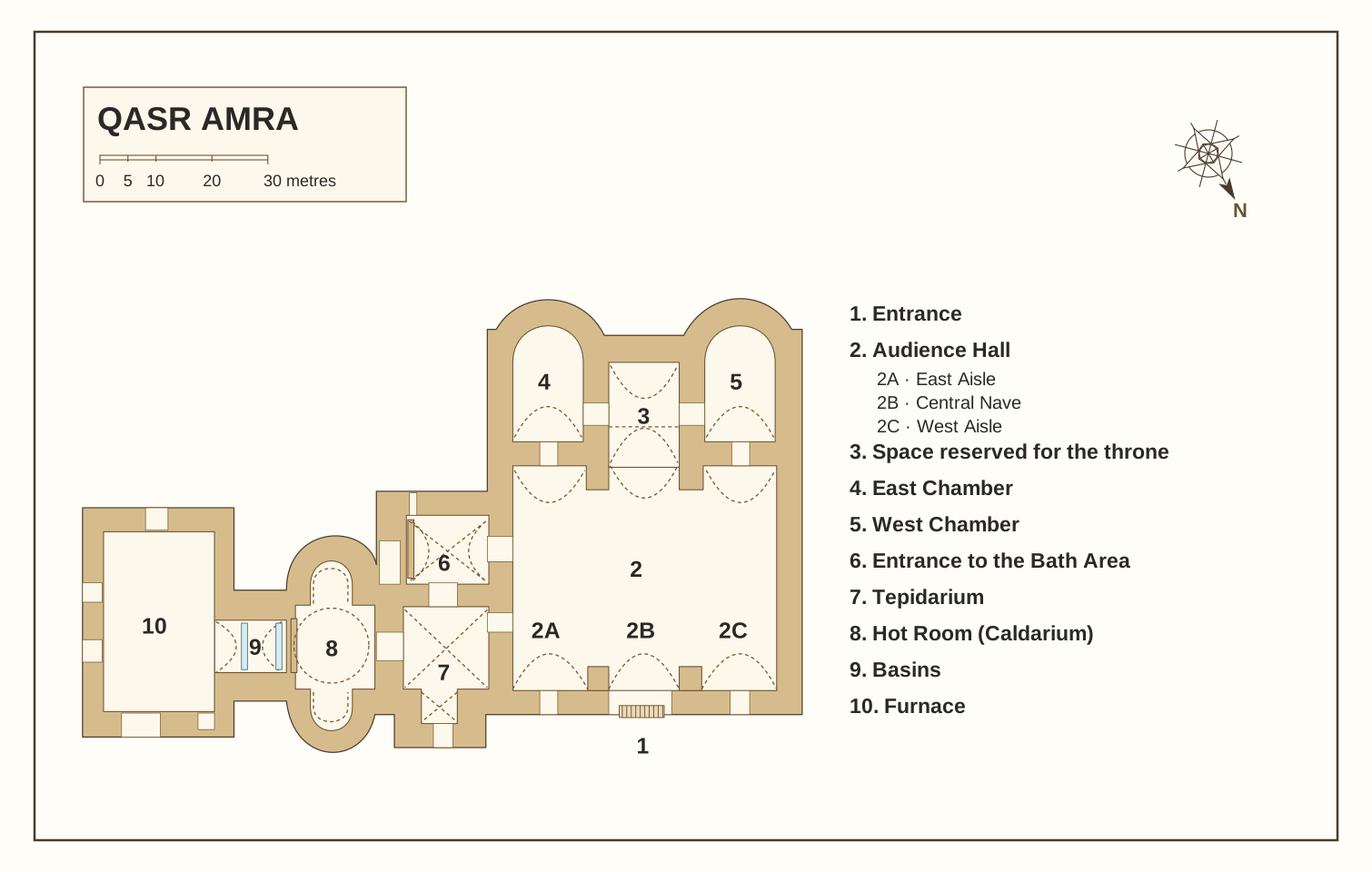
- Qasr Amra - Bath Complex Floor Plan (click on the image to enlarge)
A reception hall and a sequence of baths
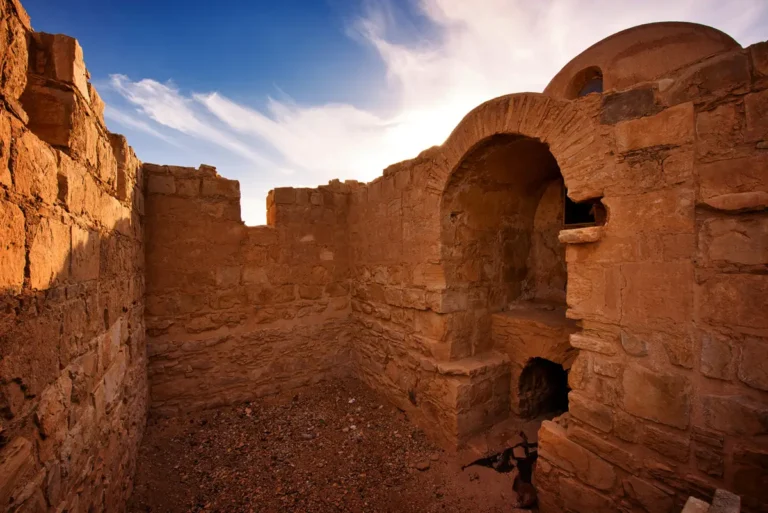
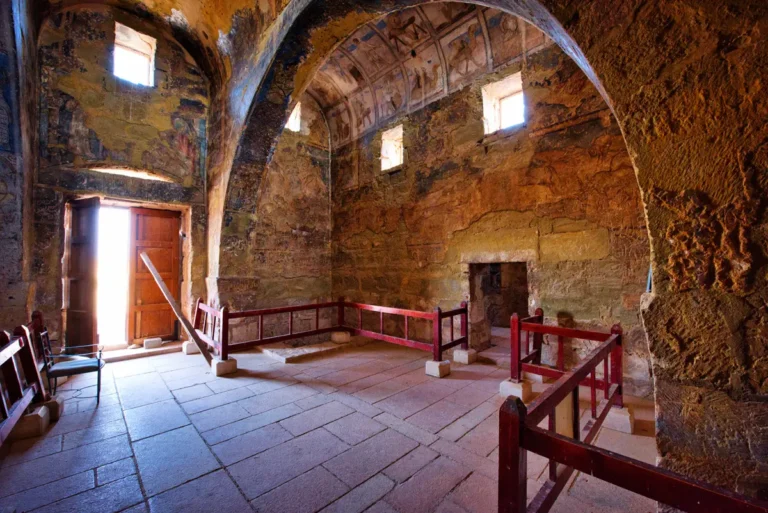
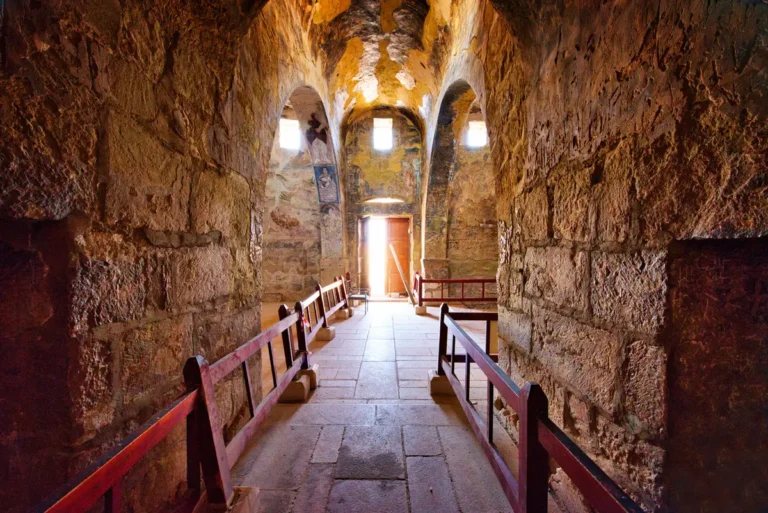
The principal hall is divided into three parallel bays, each covered by a barrel vault. At the far end, a recessed space commonly described as a throne alcove is flanked by smaller rooms.
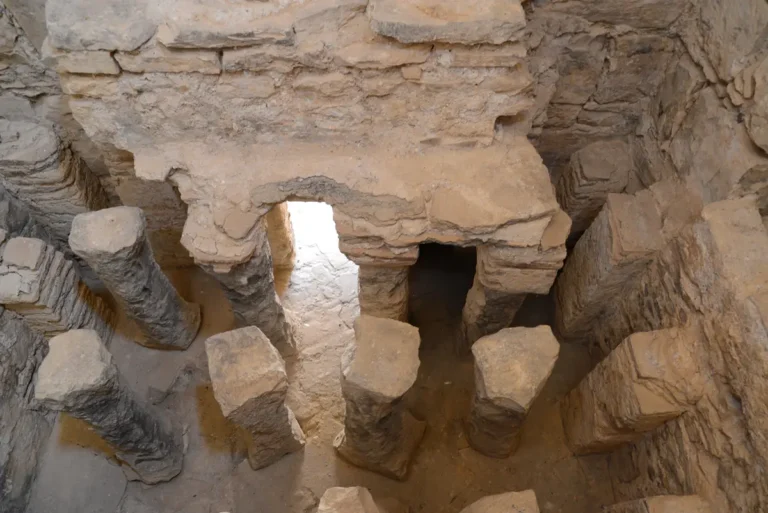
The adjoining bath suite comprises three compact chambers, conventionally identified as a changing room, a warm room, and a hot room. Their different roof forms help distinguish them: a barrel vault, a cross vault, and a dome. The arrangement draws on the long regional tradition of Roman and late antique bathing architecture.
Water lifted from below
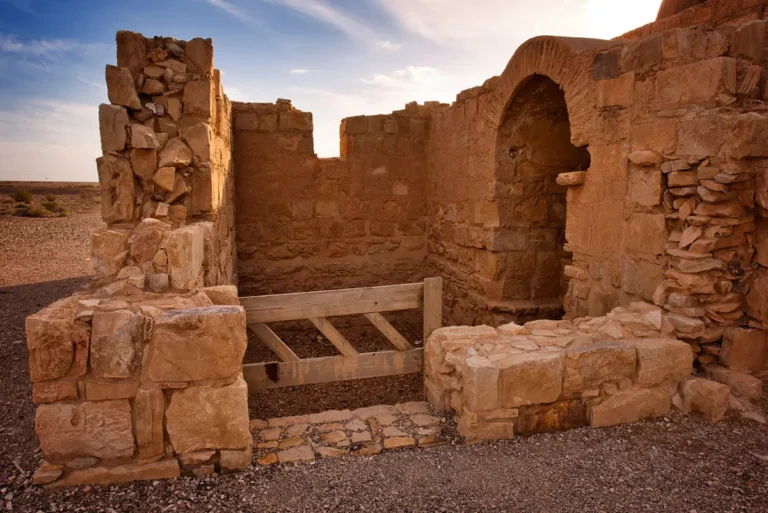
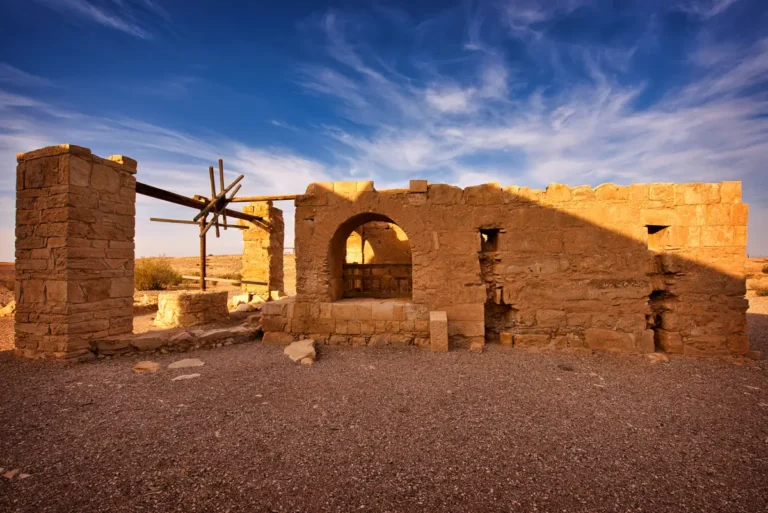
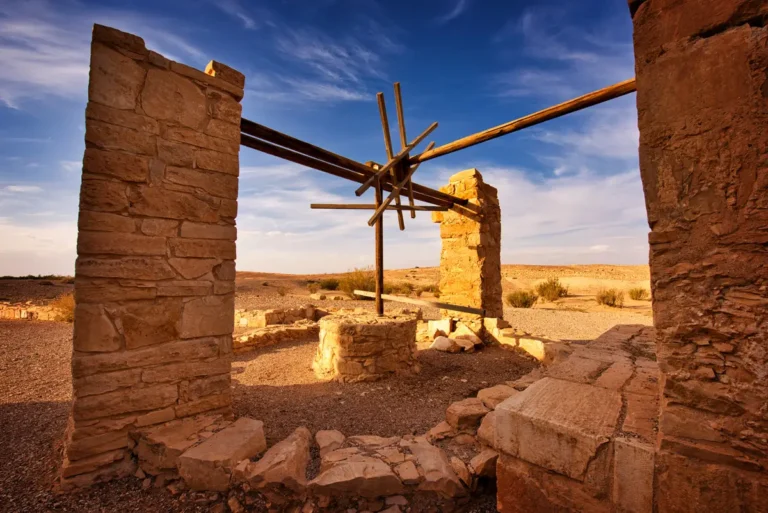
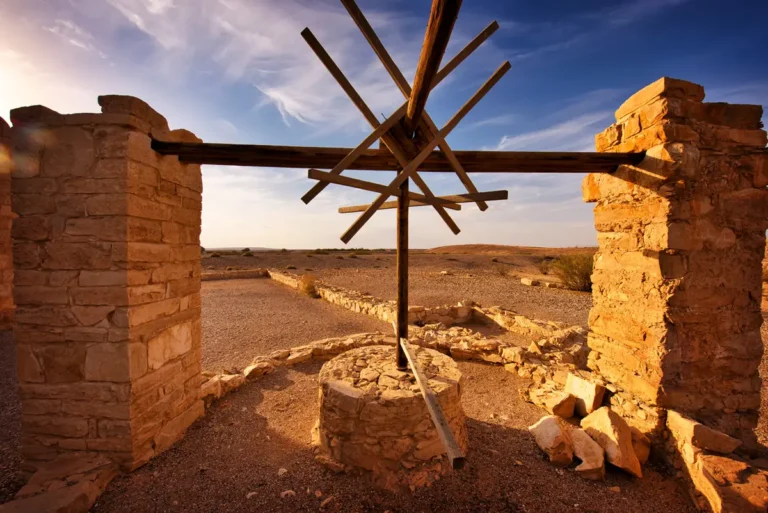
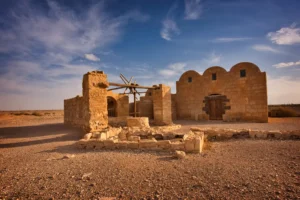
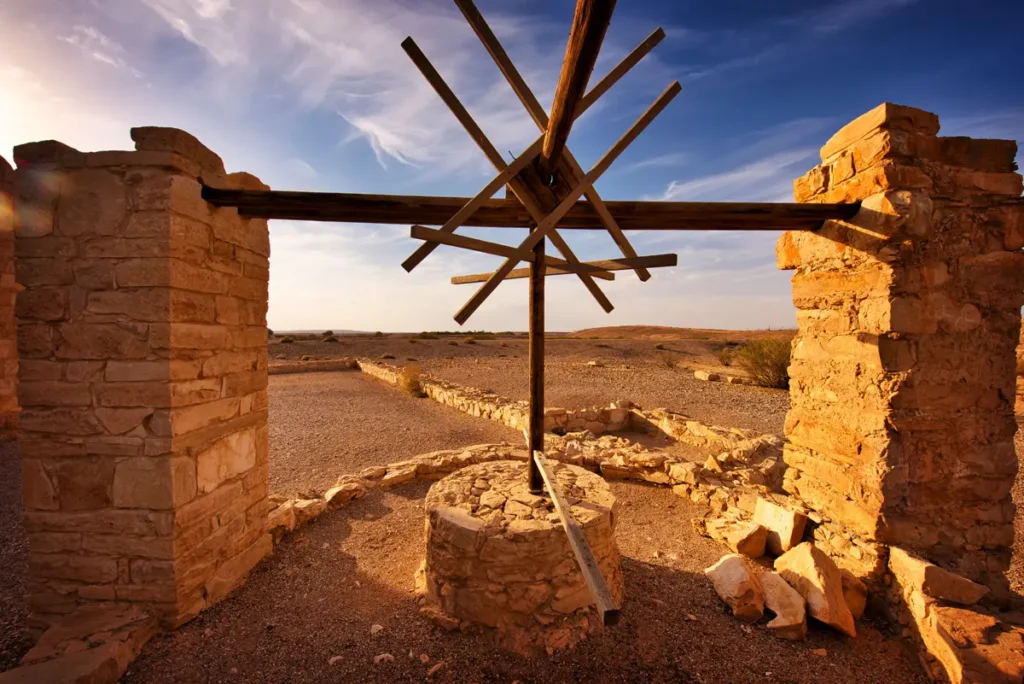
The nearby well house preserves a restored saqiya, a water-lifting apparatus associated with supplying an elevated tank. It helps explain how the baths could function in this environment. What visitors see includes restoration, rather than an untouched eighth-century mechanism.
Heat beneath the floor
The hot room’s heating installation lay beneath a floor. A passage connected the chamber’s eastern side with the furnace area, while an adjoining open service enclosure provided space for tending the fire and storing fuel.
These remains reveal a building designed around temperature as well as appearance. The comfort of the bathing rooms depended on work carried out beyond the decorated interiors.
DESTRUCTION, REDISCOVERY, AND RESTORATION
Amra’s survival should not be mistaken for an uninterrupted history of care. Its paintings have endured deterioration, deposits, damage, and successive interventions. A single dramatic destruction event does not adequately explain the building’s condition.
In 1898, the scholar Alois Musil visited the monument, beginning the work that would bring its paintings to wide scholarly attention. His subsequent documentation became an important part of the site’s modern history. “Rediscovery” describes this entry into international scholarship more accurately than it describes a place unknown to the people of the surrounding region.
A Spanish campaign between 1971 and 1974 undertook substantial conservation and structural work. French-Jordanian teams later produced extensive documentation of the paintings. Some earlier treatments, including protective coatings and repainting, subsequently complicated the appearance and interpretation of the original surfaces.
Modern work has involved Jordan’s Department of Antiquities, Italy’s conservation institute, and the World Monuments Fund. Their collaboration has addressed both the building and its painted interiors.
The inscription revealed in 2012 illustrates why conservation is also research. Cleaning can recover historical evidence, changing the questions scholars ask as well as the images visitors see.
WHAT TO SEE TODAY: A WALK THROUGH
Read the building from outside
Begin with a view that includes the principal hall and adjoining bath chambers. Identify the three long vaults and the smaller dome, then compare their positions with a site plan.
Walk only along permitted routes. An exterior circuit, where accessible, helps distinguish the decorated rooms from the infrastructure that supported them.
Examine the well and water system
Before the paintings absorb your attention, look at the well-house installation and tank. Think through the sequence: water brought upwards, stored, and supplied to the building.
This is a useful place to ask a guide which elements are ancient and which are restored. The distinction makes the surviving engineering easier to interpret.
Enter the reception hall
Take in the whole room before concentrating on individual scenes. Follow the three bays towards the far end and notice how the painted surfaces relate to the architecture.
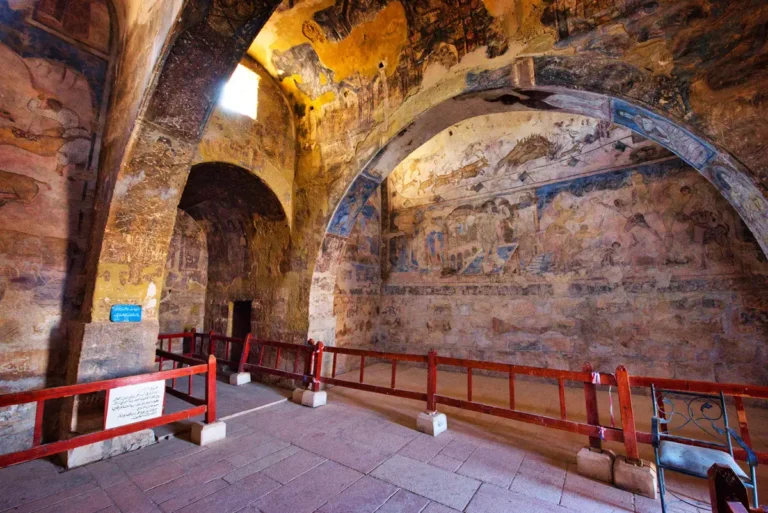
The range of subjects is part of the attraction. Hunting and courtly images share the interior with scenes of work and bodily activity. Look for differences in scale, pose, and placement rather than treating every figure as an isolated picture.
Find the Six Kings painting
On the western wall, look for the damaged group conventionally known as the Six Kings. Greek and Arabic labels identified four figures as the Byzantine emperor, the Sasanian ruler, the Visigothic king Roderic, and the ruler of Abyssinia. The identities of the remaining figures have been proposed through interpretation rather than equally secure labels.
Do not expect six crisp portraits. A reference illustration can help you recognise the surviving arrangement. The scene invites consideration of how a prince represented his place among other rulers; its precise political message remains debated.
Look towards the throne alcove
The recess at the end of the central bay forms an architectural focal point. Pause here and look back towards the entrance. The change of viewpoint helps explain how the room could direct attention towards someone occupying its far end.
Study the changing-room vault
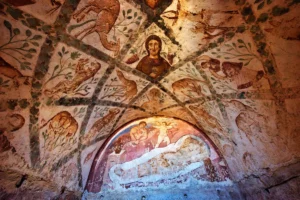
In the first bathing chamber, reddish bands divide the curved ceiling into diamond-shaped compartments. These contain animals, birds, and human figures.
Choose one compartment and examine it carefully before moving to the next. Looking at how each subject fits within its frame can be more rewarding than trying to identify the entire ceiling at once.
Continue through the warm room
The warm chamber provides a transition to the hot room. Look up to see the cross vault and how the decoration responds to its intersecting surfaces.
These spaces are small. Allow others room to pass, and avoid leaning against walls while examining the ceilings.
Look up into the zodiac dome
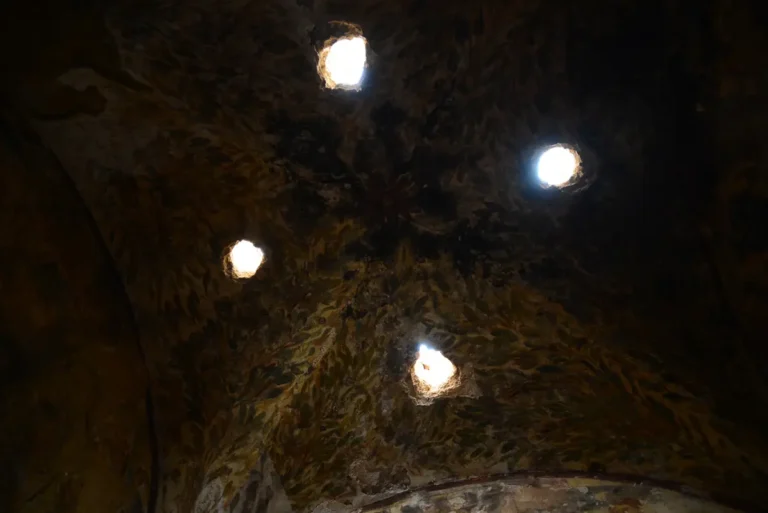
The dome of the caldarium, or hot room, carries Amra’s celebrated celestial imagery. UNESCO identifies it as one of the earliest surviving representations of a map of the heavens on a dome.
Give it time. The paintings are easier to appreciate once you have understood the curve of the surface and the relationship between individual figures and the larger composition. Its setting is especially striking: a room devoted to bodily comfort beneath an image of the sky.
Where visible and accessible, finish by examining the heating remains. They reconnect this extraordinary ceiling with the practical operation of a bathhouse.
The Inscription That Revealed a Prince’s Name
High on the southern wall of the reception hall’s western aisle, a painted inscription preserves a crucial clue to Qasr Amra’s history. Written in white Kufic lettering against a blue background, its three damaged lines invoke God’s blessing upon al-Walid ibn Yazid, the future Caliph al-Walid II.
The Inscription That Revealed a Prince’s Name
High on the southern wall of the reception hall’s western aisle, a painted inscription preserves a crucial clue to Qasr Amra’s history. Written in white Kufic lettering against a blue background, its three damaged lines invoke God’s blessing upon al-Walid ibn Yazid, the future Caliph al-Walid II.
Arabic text
The following reproduces Frédéric Imbert’s published reading, using modern Arabic type. It retains unusual spellings and incomplete words rather than silently correcting them. Brackets indicate missing or reconstructed material; dots mark unreadable passages.
(١) اللهم أصلح الوليد بن يزيد بالصلحية عبا [...]
(٢) لحق الصالحين وأحيطه برد [ر]حمه يولي العالمين
(٣) ولأمته خلد ... الملة يوم ... جميع عل [...]
Source: Frédéric Imbert, Le prince al-Walīd et son bain, p. 332.
English translation
An English rendering following Imbert’s interpretation is:
1. O God, make al-Walid ibn Yazid righteous through the virtue of […]
2. [Let him] join the righteous. Surround him with the gentleness of kinship, O protector of the worlds!
3. And for his everlasting community … the religion on the day of … all of …
The second and third lines are especially uncertain. This is a scholarly interpretation of damaged writing, rather than an uninterrupted prayer preserved in full. Imbert, p. 332
What does it tell us?
The name is the strongest evidence.
The clearly readable opening—اللهم أصلح الوليد بن يزيد, meaning “O God, make al-Walid ibn Yazid righteous”—connects the monument with the prince who became caliph in 743 CE. It provides decisive support for identifying Qasr Amra’s patron. Palumbo’s conservation study
It helps date the building, but gives no surviving construction date.
The prayer does not call al-Walid “caliph.” Together with other evidence, this supports placing the commission during his years as heir apparent, before 743. The frequently suggested construction period of approximately 730–743 CE is a scholarly conclusion, not a date written in the inscription. Palumbo’s conservation study
Its wording has been reconsidered.
Earlier translations referred to the “freshness of mercy” and “Lord of the worlds.” Imbert subsequently revised his interpretation of the damaged passages. These different versions should not be combined into a supposedly complete original text. Discussion of the readings
It adds a devotional voice to the painted setting.
Among images of royal authority, bathing, and courtly pleasures, the prayer asks for moral goodness and divine care. It suggests that religious devotion and princely self-presentation belonged together within the monument’s decorative programme. Palumbo’s interpretation
PRACTICAL VISITING TIPS
Allow time for close looking
Plan 30–40 minutes for a considered visit. Art enthusiasts may prefer longer, particularly with a knowledgeable guide. These are suggested allowances rather than official visit durations.
Check the opening schedule
The official Jordan Pass timetable publishes the following hours for the Desert Castles:
- Winter: 8:00 am–4:00 pm
- Summer: 8:00 am–6:30 pm
- April and May: 8:00 am–5:30 pm
- Ramadan: 9:00 am–5:00 pm
The timetable’s winter date range overlaps April, while its individual attractions page gives a general 8:00 am–5:00 pm listing. Confirm the schedule for your travel date, particularly if arriving late. Seasonal opening hours, attraction listing.
Tickets and Jordan Pass
Published admission is 3 JOD for foreign visitors and 0.25 JOD for Jordanians. Jordan Pass includes the site; bring your pass and identification.
Prepare for the exterior and interior
Bring drinking water, sun protection, and comfortable shoes. The walk outside and time spent studying the paintings call for different kinds of preparation: sun protection for the approach, patience and careful footing inside.
Protect the paintings
Keep hands, clothing, and bags clear of the walls. Follow staff instructions about photography and use available light rather than flash. Do not enter closed areas or cross barriers for a better view.
Moisture, salts, and changes in humidity are among the conservation concerns affecting Amra’s paintings. Visitor management is part of their protection.
WHY QASR AMRA MATTERS
Qasr Amra preserves something that stone walls alone rarely convey: the images people chose to live among. Its paintings bring us close to a princely environment in which political ambition, bodily pleasure, skilled work, animals, and the heavens could occupy neighbouring surfaces.
They also complicate any narrow expectation of early Islamic art. Human figures and inherited artistic traditions belong here alongside Arabic invocations and the ambitions of an Umayyad patron. The building asks to be understood within that particular historical setting.
The most lasting impression may come in the smallest room. Beneath the painted dome, the distance between an eighth-century visitor and a modern one briefly contracts: both look upwards. What each understands is different, but the invitation to look remains.
Frequently Asked Questions
Qasr Amra is famous for its eighth-century wall paintings, which depict rulers, hunting scenes, musicians, animals, and bathing figures. Its most celebrated feature is the celestial dome in the hot room, where constellations spread across the ceiling. These paintings offer an extraordinary glimpse into Umayyad courtly culture.
Yes. Qasr Amra, Qusayr Amra, Quseir Amra, and Qusair Amra are different English spellings used for the same monument. UNESCO lists it as Quseir Amra.
The building is attributed to the Umayyad prince al-Walid ibn Yazid, who became Caliph al-Walid II in 743 CE. Scholars commonly suggest a construction period of approximately 730–743 CE, although the precise date remains uncertain. An inscription revealed during conservation in 2012 provides crucial evidence by naming the prince.
The surviving painted building was principally a reception hall and bathhouse within a larger Umayyad establishment. It provided a setting for bathing, hospitality, and elite gatherings. Remains of other buildings, including a fort or garrison complex, survive nearby. The familiar term “desert castle” describes the broader category of monuments rather than the specific function of every building.
Inscribed in 1985, Qasr Amra is recognised for its exceptional Umayyad paintings and its importance as an early Islamic architectural ensemble. Its combination of figurative murals, bath chambers, and water infrastructure preserves rare evidence of the period’s art and daily life.
Look for the Six Kings painting, the seated ruler in the throne recess, scenes of work and leisure, and the painted ceilings of the bath chambers. Finish with the celestial dome in the hot room. A guide or illustrated reference can help you recognise figures that are faded or fragmentary.
Qasr Amra stands beside Wadi al-Butum in Jordan’s eastern desert, approximately 75 kilometres east of Amman. It lies along the desert-castles route towards Azraq, making it a practical stop on a day trip from the capital.
The official seasonal timetable for the Desert Castles lists 8:00 a.m.–4:00 p.m. in winter, 8:00 a.m.–6:30 p.m. in summer, and 9:00 a.m.–5:00 p.m. during Ramadan. A separate April–May schedule lists 8:00 a.m.–5:30 p.m. Official pages give overlapping or differing schedules, so confirm the closing time locally, especially during seasonal transitions.
Avoid touching or leaning against decorated surfaces, and keep bags clear of the walls in narrow spaces. Follow staff instructions and posted photography rules; if photography is permitted, leave the flash off. The paintings are fragile, and their preservation depends on careful conservation and considerate visits.
Key Moments in History
Around 730–743 CE — A prince’s painted retreat
Qasr Amra is probably built for the Umayyad prince al-Walid ibn Yazid, the future Caliph al-Walid II. Its reception hall and bathhouse become a remarkable canvas for courtly life: hunters, musicians, rulers, and constellations share the walls and ceilings. The precise construction date remains uncertain.
14th–16th centuries — Travellers leave their mark
Arabic graffiti bear witness to visitors passing through long after the building’s royal beginnings. Some inscriptions suggest that pilgrims stopped here on their journey to Mecca. The surviving evidence reveals continued encounters with the monument, although the date when its original functions ceased remains unclear.
Key Moments in History
Around 730–743 CE — A prince’s painted retreat
Qasr Amra is probably built for the Umayyad prince al-Walid ibn Yazid, the future Caliph al-Walid II. Its reception hall and bathhouse become a remarkable canvas for courtly life: hunters, musicians, rulers, and constellations share the walls and ceilings. The precise construction date remains uncertain.
14th–16th centuries — Travellers leave their mark
Arabic graffiti bear witness to visitors passing through long after the building’s royal beginnings. Some inscriptions suggest that pilgrims stopped here on their journey to Mecca. The surviving evidence reveals continued encounters with the monument, although the date when its original functions ceased remains unclear.
1898 — The paintings reach a wider audience
The Czech scholar Alois Musil visits Qasr Amra, helping bring its extraordinary paintings to international scholarly attention. The building was already known locally; his visit marks a turning point in its documentation rather than its first discovery.
1901–1907 — A painted world is recorded
Musil returns in 1901 with the artist Alphons Leopold Mielich to document the interiors through drawings, photographs, and measurements. Musil’s major publication follows in 1907. These early records become valuable historical evidence, although cleaning and the removal of painted fragments also damage the monument.
1970s — A major restoration campaign
Spanish specialists undertake extensive conservation, removing soot from the paintings and stabilising parts of the building. Their work makes many scenes more visible, but protective coatings and repainted outlines later complicate both conservation and interpretation.
1985 — UNESCO World Heritage recognition
Qasr Amra joins the UNESCO World Heritage List. Its remarkable murals, surviving bath complex, and celestial dome earn recognition as exceptional evidence of Umayyad culture and early Islamic art.
1989–1995 — A closer study of the murals
A French–Jordanian project undertakes further documentation and study, helping researchers distinguish the original paintings from later alterations and better understand their intricate imagery.
2010–2012 — Conservation reveals a royal name
A new conservation campaign begins in 2010. In 2012, cleaning reveals an inscription naming al-Walid ibn Yazid, providing crucial evidence for identifying the patron and revising earlier attributions. Beneath accumulated deposits and past treatments, the building begins to tell its history more clearly.