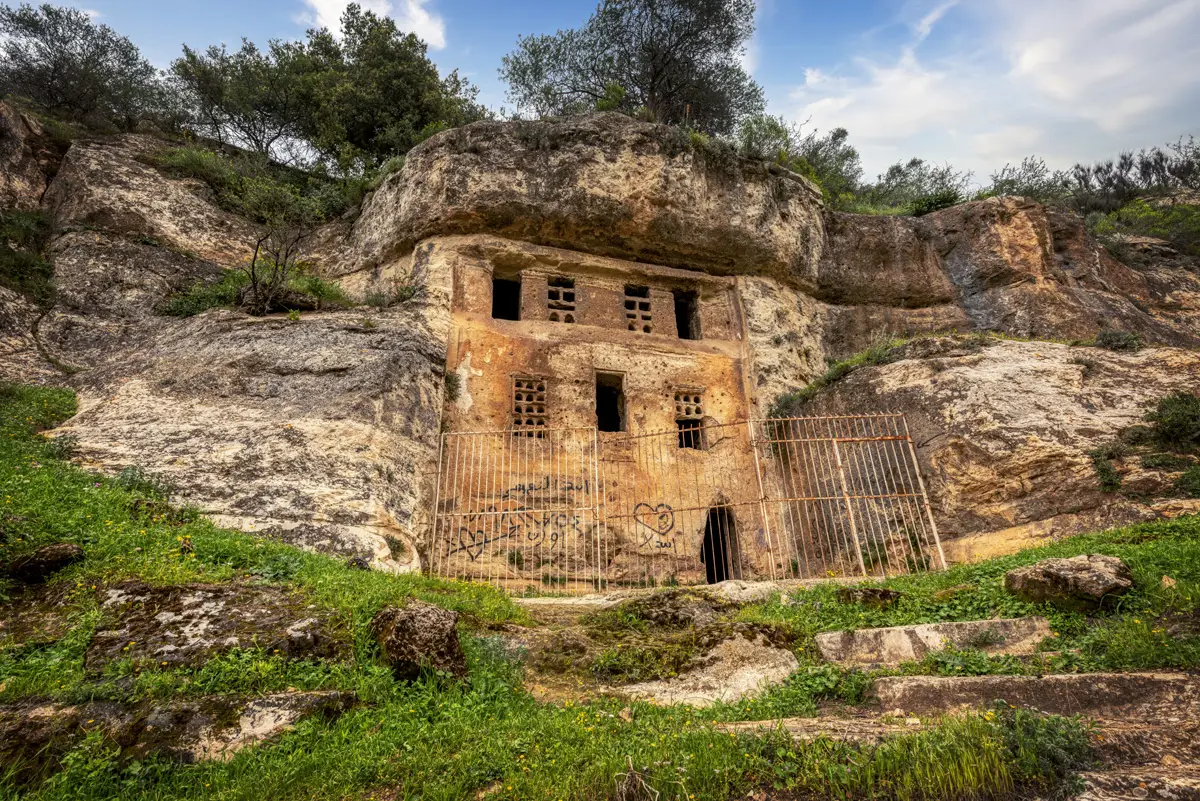

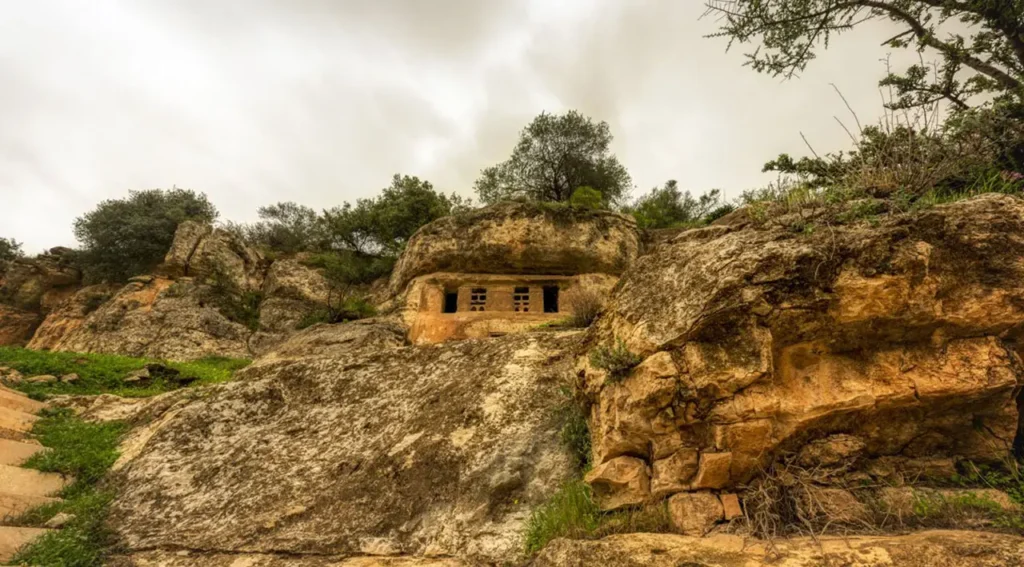
High in the cliff on the south side of Wadi al-Seer, a cave opens onto the valley. Inside, its walls are covered with rows of small triangular niches — a columbarium, or dovecote, where pigeons were kept. Local people once called it “the pharmacy of doves”; its Arabic name, Muallaqat al-Dayr, means “the hanging place of the monastery”.
Where Is Muallaqat al-Dayr?
The dovecote is on the south side of Wadi al-Seer, about 14 km west of central Amman and about 4 km west of the town of Wadi al-Seer, on the road to Iraq al-Amir. A little further along the same road are the cave church of Al-Bassah, the caves of Iraq al-Amir and Qasr al-Abd.
Historical Context and Origin
Nobody knows exactly when the dovecote was cut. Some have compared it with an Ammonite dovecote at ‘Ain al-Baida in Amman, dated to the late 8th–6th century BC, and suggested an Iron Age date; others think it is medieval. No excavation has dated it directly.
Columbaria were common across the ancient Near East — at Jericho, Jerusalem, Masada, Herodium and Petra, among others. Pigeons provided meat, birds for sacrifice and, above all, dung: a valuable fertiliser for fields and orchards.
Architectural Design
The dovecote is cut into the rock as two chambers, more than 7 metres high. Their walls are lined with small triangular niches arranged in rows; one modern count gives about 800. The 19th-century explorer Claude Conder described it differently, as a burial place with some 2,300 niches for monks’ skulls — a reading that explains the “monastery” in its name.
Hundreds of Niches
Rows of small triangular niches cut into the rock walls — about 800 by one count.
Two Chambers
The dovecote is cut as two chambers, over 7 m high.
A Hanging Cave
The name means “the hanging place of the monastery” — the cave hangs high in the cliff.
Why Pigeons?
Dovecotes supplied dung for fertiliser, young birds for food, and birds for sacrifice.
Visiting Muallaqat al-Dayr Today
A short road leads up from the roadside nursery and café, followed by a staircase to the cave. Step inside to see the niches rising in rows on the walls, and look out over the green valley of Wadi al-Seer.
Further reading: ASOR: Pigeons in the Roman and Byzantine Near East.